Showing posts with label training. Show all posts

Tuesday, 25 July 2017

Outlaw Triathlon - Part 1: The Training

This is one of a three part set of posts about my first iron distance triathlon: Outlaw Triathlon 2017. This post covers my pre-race training. You can also read my review of the event and the analysis of my race performance.

It had always been on my long-term goal list to complete an iron distance triathlon (2.4 mile swim, 112 mile bike and 26.2 mile run). So, when some members of my club (Team Kennet) suggested taking on the Outlaw Triathlon I had a good think and decided to give it a go.

My main worry was the volume of training required to be competitive at an event of this duration. However, over previous years, my typical training load has been somewhere between eight and twelve hours a week, which seemed fairly compatible with many ironman training plans. The big difference was just the addition of the weekly long ride, which I was successfully able to negotiate with my family.

I started training in October 2016 for the race at the end of July 2017. Initial training was just base fitness work, strength and conditioning, yoga and general preparation for the winter's cross-country running season.

For the main training block I selected the Don Fink 30-Week Competitive Training Plan. I liked the fact that this plan is fairly run heavy, which fits in well with my season's other running events such as half marathons and athletics track season. Also, three other members of my club, who were also doing the Outlaw, decided to follow the same plan as well so this synchronised well in terms of being able to do some of our long rides together.

Swim

The training plan called for three swim sessions per week. I was already doing two sessions most weeks: one club session and one on my own. I was therefore able to add an extra session, usually in a lunch break, with more open water focus closer to the event.

Working with my club coach I was able to make some big strides in my swimming, going from pacing around 2:10/100 over 1,500 meters down to being able to sustain 1:58/100 over the 3.8k swim distance. Lots of changes working first on getting my legs higher in the water; then on building a better supporting platform with my arms while breathing; finally working on a stronger catch and pull-through with a lower but more effective stroke rate.

A couple of 4k+ open water lake swims in the month before the race gave me the confidence that I could comfortably achieve the race distance.

I broadly followed the swim sessions from the training plan, except on club nights when I did my coach's planned session. The main adaptation was that I had to cut a fair few of the Don Fink sessions to make them shorter as my swim speed wasn't sufficient to fit in the entire set within the allotted swimming time.

Bike

I've been gradually improving my bike over the last couple of years, but mainly focussed on olympic triathlon distance. Prior to starting the training plan I'd only ever done one ride over 100 miles in length!

Lots of turbo trainer sessions on Zwift took place over the winter to get the base bike fitness locked in. Then starting in March I started moving outside. A very warm May and June made some of the rides quite tough, but I could feel my cycling improving each week and my average speed getting better on each ride.

The Don Fink plan typically has 4 rides each week: a session with some speed/intervals work, a shorter brick ride, a long ride (starting at 2 hours and building up to 6) followed by a run, and an easy spin at high cadence. I typically did the easy spin on the turbo and the others all outside.

For my longer rides, most were undertaken along the A4 between Thatcham (where I live) and Bath. This is a relatively flat route with similar (but fractionally hillier) terrain to the Outlaw bike course, so most of my long training was very race specific.

About half the long rides were done with my club mates (with plenty of drafting going on), great for building up the distance without maxing out the effort. I also took care to make sure that I did three of the very long rides solo: firstly to make sure I could sustain the required effort on my own; and secondly, to do the mental preparation of six hours of focused riding with no banter!

Over time my bike speed gradually improved, starting out about 27kph average on the first long ride and settling at just over 29kph by the later rides. I was therefore hopeful that on slightly flatter Outlaw route that I might be able to maintain an average speed above 30kph.

Run

Running has always been my primary (and strongest) event. Having completed a sub-3-hour marathon in 2016 I was very confident for a good run time. The Don Fink plan has quite a good run focus, but I did do a few variations to ensure that my running was compatible with racing a half marathon, a 10k and athletics track season during the training period.

Typically my run training consisted of two track sessions per week: one very hard intervals with longer rest periods and the other slightly less hard but with shorter recovery. Also included was a long run, starting at about 18km and building to 32km in the peak phase. Other runs were just brick sessions, mostly done easy and Parkrun with the kids as a recovery run. Typically doing five runs per week.

One specific thing that I did was to make sure that the brick run after my long rides was always done at target marathon race pace to that I got used to running at that speed straight off the bike.

Conclusion

Overall, the training was just about spot on. The Don Fink plan worked great and I found myself in peak condition at race time. The big four peak weeks in the plan were super tiring, but that was always to be expected. I think the plan had the perfect mix of swim, bike and run balance for my needs. I also managed to fit in a one-hour yoga session each week, which really helped with maintaining flexibility.

During the training period I was also able to complete a 1:23:11 half marathon and a sub-40 10k plus also my first middle distance triathlon as well.

Probably the only change I would make would be to try to be much more focused on getting a strength and conditioning session in each week. I started out well, but during the second half of the plan this was always the session that got dropped each week due to time constraints or tiredness.

The other thing that I would strongly recommend is undertaking training for an event such as this with friends and club mates. Going out for a group long ride made them so much more bearable. Having a social media message group also allowed us to provide support to each other and keep a bit of banter going when the going got tough. I think the whole process would have been far tougher mentally if I'd tried to do it solo. Thanks Sean, Chris, Bart, Dean and Cameron!

Tuesday, 15 December 2015

Zwift - Making the Turbo Trainer Less Dull

Just over a month ago I finally bit the bullet and purchased a turbo trainer. I didn't really want to as I much prefer riding outside, but I did have a few good reasons:

  • I've spent the summer building up good cycling fitness and gradually improving my power output and I don't want to loose that completely over the winter and have to start from scratch again in April/May
  • We are entering the winter and while I don't mind riding in the cold and wet I really don't want to be risking icy roads - where a crash on the bike could ruin my spring marathon training
  • Riding indoors has the advantage that I can train and keep an eye on the kids and my wife can use the same time to go out for a run

I've therefore set myself an objective of maintaining at least one ride of between 60 and 90 minutes each week (usually on the turbo) throughout the winter as well as regular rides to work (only a couple of miles each way).

Turbo Trainer Purchase

With this in mind I purchased a barely used CycleOps Fluid 2 trainer off of eBay. I couldn't justify going for anything much more expensive given the relatively limited amount of use it's going to get. However I did spend enough to get a fluid model as these have significant advantages of smoothness and quietness over cheaper magnetic or fan based systems.

Level of noise was a big consideration as I'm usually cycling early in the morning and need to avoid waking the kids! I'm very pleased with the Fluid 2: it rides nicely and doesn't really generate any more noise than the washing machine.

First Sessions

The first two sessions I undertook on the turbo were mind-numbing! I opted to do a couple of structured workouts from a training plan, each of 60 minutes duration. For entertainment I went with trying to catch up with my backlog of running and triathlon podcasts.

I pulled off each of the sessions successfully, but the time just seemed to go so slowly. A 5-minute interval seemed like an age. Twenty minutes seemed never ending. I knew that if I was going to make it through the winter riding the turbo then I had to find something to make the whole experience less tedious.

My first thought was watching movies or TV series on the iPad while riding, but I wasn't really sure that would be much different to listening to a podcast. Then I saw an article (or mayby email) about Strava offering two months free access (for premium members) to something called Zwift...

Virtual Riding

The main premise behind Zwift is that it allows you to ride in a virtual environment with other riders from around the world. The data collected from sensors attached to your bike/trainer (see later) controls how quickly your rider travels through the virtual environment. Imagine a computer game where you are riding a bike and the speed is based on the cycling effort you put in on a real bike – that's pretty much it.

You have the option of just riding the course on your own, picking up other riders or a group and riding with them or even completing a specific structured workout. During general riding there are sprint and hill climbing challenges where you compete for the fastest time against the other riders in the game, plus the option to go for the fastest course lap.

Equipment and Sensors

So, how does all this magic work? First off you need a computer (PC or Mac) that runs the Zwift game. This needs to have a pretty good Internet connection so that you can see your position in the virtual environment along with all the other riders from around the world. I've found that the game is pretty processor intensive, so having the laptop plugged in seems to be essential.

Next off you need a turbo trainer and of course a bike! Zwift works best with a smart trainer where the game can control the trainer resistance to match the virtual hills on the course. However, it works just fine with a classic trainer and there are pre-calibrated profiles for most of the main manufacturers (Tacx, CycleOps etc.)

Finally you need some sensors to measure what you are doing on the bike. Ideally you should have a power meter as the game is largely built around power: so you will get the most accurate behaviour by using a real power meter. However if, like me, a power meter is beyond your budget then it also works just fine with a standard speed sensor – in which case Zwift use an algorithm to estimate your power. So far, the estimation seems to be pretty accurate as far as I can tell. You can also pair a heart rate monitor and cadence sensor for additional metrics.

By default Zwift works with Ant+ devices, and you will need an Ant+ USB dongle in your laptop. However, it's also possible to run the Zwift App on your mobile device, which allows pairing with BLE devices as well. The App and the computer must be on the same network so that the App can transmit the readings from the BLE sensors to the game. Additionally, the App also works as a cycle computer display and controller for the game, so it's pretty useful even if you aren't using any BLE devices, and it stops you dripping sweat all over the laptop!

This all ends up being quite a complex configuration of kit with lots of interconnecting parts (Internet, computer, phone App, bike sensors, hrm, trainer). There's quite a lot that could go wrong here, but surprisingly it works incredibly well. I had one small problem getting the phone App and the game on the laptop to communicate properly resulting in no reading from my BLE speed/cadence sensor, but once everything is communicating fine it seems really stable throughout the ride.

Riding Experience

The riding experience is really good, even with a classic trainer. As you ride, Zwift uses your power output (either measured or calculated) and translates this into a relative speed within the game. As the virtual course goes uphill, your virtual speed at the same power output goes down and visa-versa as the course goes downhill again.

I thought initially that it would seem strange going from flat to uphill without any change of resistance from my basic trainer, but the visual perspective of the course is good enough to trick your mind into thinking it's climbing a harder hill even though nothing in the real-world environment has actually changed. I have however taken to switching up a gear or two on the hill climbs just to make it feel tougher!

The virtual sprints and hill climbs are a great incentive to push a little harder, and seeing yourself on a leader-board against other riders from around the world is great. There's an inherently social element to riding with other people, seeing where they are from, what kit they've selected, how their performance relates to yours and so on. You can even chat and give a virtual 'Ride On!' along the way.

I've certainly found the experience immersive enough that even a 70 minute turbo trainer session seems to fly by much more quickly than before I started using Zwift. It really feels like you are out for an actual bike ride.

Workout Mode

For those who don't want to just ride round a virtual course, there's also a workout mode. You start by picking a workout from the list (I think a workout designer has just been released or is coming soon). You then ride the workout, with the game prompting you what your current interval power output should be and how long to maintain it before the next interval. There's also a virtual FTP test you can do as well.

In workout mode, you don't get to compete in the sprint or hill climb segments and you also don't get any benefit from drafting. You are however riding around the same course as everyone else so the full virtual experience and social element is still there.

Stats and Metrics

As you ride you can see your current power output, cadence, heart rate, virtual distance and speed. You also collect experience points that unlock new clothing, bikes and wheels that you can use in-game.

Once you stop riding there's a nice little summary screen with a couple of graphs and some power statistics. What's even better is that if you've linked your Strava account to Zwift then the ride is uploaded to Strava as a virtual ride along with all the data, virtual segments and Strava analysis. What a great idea!

Ride On!

I'm currently enjoying my 2-month free Zwift usage that now comes with my premium Strava account. However, I'm getting enough value from the Zwift experience that when this runs out I think I'll be paying my monthly subscription in order to see me through to the end of my winter bike training.

Wednesday, 4 November 2015

More Stryd Experiments

In my previous post I described my first impressions of the Stryd running power meter. I've now had a chance to do a few more interesting runs and so far the power readings are looking pretty good.

Lactate Threshold Session

The first run I did since my last post was a Lactate Threshold session. This was 6km long with about 1.5km warm-up and then the remainder at my lactate threshold pace of 3:58/km. This is the pace I ran my fastest half marathon at and gives me an average heart rate of somewhere in the high 160's.

This run was recorded using the Stryd Beta iOS App synced straight to the Stryd Power Center (all graphs below are extracted from Power Centre). I also ran with my Suunto Ambit3 paired with a different heart rate strap to compare data sets. Happily the data from Stryd Power Centre matches pretty closely to that recorded by the Ambit3

Power vs Elevation vs Heart Rate

This graph shows plots for the LT part of the run with power in orange, heart rate in purple and elevation in pink. It's quite obvious to see that I had big power spikes on each of the two small hills that made up the run (around 8 minutes and 16 minutes in). You can also see a power drop during the downhill section (10 minutes).

Certainly something to work on in the future is trying to smooth these spike by adjusting effort and pace in order to maintain a steady power level throughout the run. I believe that this is much more the objective when running with power as the primary metric.

As expected, my heart rate gradually raises over time as I start to tire and this is usually what I see when I'm trying to maintain a consistent pace for a period of time. What is interesting is that average power output seems to remain fairly steady even though heart rate is going up.

What's also very noticeable is the steep rise in heart rate corresponding to the power spikes on the hills and that although my heart rate decreases after each hill it never returns to the level that it was at before that hill. I would expect that by trying to smooth out the power spikes on those hills, I would also get a much lower heart rate increase and perhaps be able to achieve a lower average for the same pace across the whole run. Something to test out in a future session and a good long term goal to aim for.

Power vs Pace

The second graph plots for the LT part of the run with power in orange and pace in blue. Not sure what happened between 12 and 13 minutes into the run as my Ambit3 didn't record such a pace fluctuation, so I'm going to assume this is just a data anomaly with the iPhone GPS readings.

What you can see from this graph is that I maintained a consistent pace across the whole run, even though there were a few small hills along the way. This consistent pace is the cause of the power spikes and heart rate raises on the hills. Again, next run the aim will be to try to keep a consistent power and let the pace vary as necessary.

Average Power Output

If I exclude the power spikes, caused by inconsistent pacing on the hills, and focus just on the two flat sections where power was steady I'm achieving an average power output of 345 watts (4.6 watts/kg). This seems fairly consistent with my 250 watts (3.3 watts/kg) recovery pace output and gives me a fairly decent baseline power figure for future Lactate Threshold sessions and half marathon efforts.

Track Intervals Session

The second run that I did was a session on the track. The entire session is shown on the plot below with power in orange, heart rate in purple and pace in blue:

This was all recorded on my Ambit3 using a second HRM strap to capture the heart rate data (as dual power and heart rate from Stryd to Ambit3 doesn't currently work). The session was divided as follows:

  • Minutes 0 to 5: 800m easy warm-up
  • Minutes 7 to 13: drills (skips, high knees, heel flicks etc.)
  • Minutes 13 to 22: short sprints (about 30m at 80% effort)
  • Minutes 22 to 55: intervals – pyramid of 200-400-600-800-600-400-200m efforts with the same distance as the previous interval jogging recovery between each
  • Minutes 55 to 60: 800m easy cool down

Zooming in on just the intervals pyramid, we get the following graph:

Overall

The one thing you can clearly see is how well power tracks pace and reacts almost instantaneously. Given these were all fairly short bursts, heart rate is also following along quite well, but you can clearly see the lag at the end of each interval as it slowly returns to the recovery level. You can also see how my max heart rate increases each interval, making it a less than ideal measure of intensity compared to power.

Intervals

Power levels look pretty consistent as I would expect. The power for the first 200 is higher than any other interval (the last 200 was slow as I had a sore calf muscle at this point). The 400's have a higher power than the 600's and the 800. Both of the 600's and the 800 have a raising power towards the end as I pushed a bit harder.

Interestingly most of the intervals have a power dip at some point around the middle, probably indicating that I'm going off too fast and then slowing down too much in compensation. This isn't really noticeable on the pace graph, so either the stryd is giving me a valuable insight (which I suspect is actually the case) or it's not got it's power measurement quite right. Certainly something to play around with on my next track session.

The average power figures for each interval are:

200402 watts
400388 watts
600358 watts
800369 watts
600362 watts
400388 watts
200377 watts

It's good to see that each interval either side of the pyramid has roughly identical average power. Interesting also how the 800 interval has higher watts than the 600's. However, looking at the pace graphs, I started out the 800 a bit too fast, which probably accounts for this figure.

One other thing I learnt is that using this data I am able to work out an approximate 3 minute sustainable power of something around 370 watts (4.9 watts/kg).

Recoveries

Between each interval there was a recovery period of the same distance as the interval just completed. I'm running all of these pretty steady and consistently at a relaxed pace of about 5:40-5:50 per km. Both the pace and power seem quite steady.

What is interesting from these is that average power is around 250 watts, whereas a previous recovery run had me being able to maintain 250 watts off a much faster 5:10/km pace. My suspicion is that this clearly shows a drop in running form due to fatigue from a hard interval (although see the next section also for another idea). Clearly something to work on is focusing on the power during these recoveries and trying to keep it as low as possible by maintaining good running form even though fatigued.

Warm-up and Cool-down

One slightly strange observation from this session was during the warm-up and cool-down laps. Given that these were on the track and an average pace of about 5:30/km I would have expected much lower power readings than the 250 watts that I have seen during recovery runs at 5:10/km pace on undulating roads. Instead, my power was still averaging out at about 250 watts.

I have three hypothesis to play with here:

  • I run less efficiently while warming up and when tired at the end of a hard session (quite likely, but easily tested)
  • 250 watts is some magical minimum figure of the amount of power that I require to get me running and I can only go up from that point
  • My optimum efficiency pace is about 5:10/km and trying to run slower than that actually requires me to compromise my running performance (e.g. slower cadence, shorter strides) and that's less efficient and needs more power

This is definitely another area to play around with a bit more. I'm doing some slow runs with my children at the weekend, so will see how the results of these compare.

Multi-Terrain Run

The final run that I did was a multi-terrain recovery run. This wasn't anything particularly special as it was pretty slow and in horrible wet weather. Basically I just ran round a field five times while my boy was football training on the pitch in the middle! However what is interesting is the power map generated by Stryd Power Centre:

This map is coloured by power, with a scale from green being the areas of lowest power on the run and red being the areas of highest power, with orange being the middle between the two. Pace was a steady 5:30/km for the entire run and the terrain is pretty much flat the whole way round (3m elevation change round the whole 1km loop).

What is very evident from this picture is the change of power with the change of running surface. The bottom right section is mostly green and corresponds with a tarmac footpath and car park. The right hand side is the highest power and this corresponds to the transition from tarmac to longer grass. The entire top is in longer grass, except for the very small section directly above the football pitch that was well manicured. The left hand side was short grass but slightly wetter, while the bottom left was another area of well manicured grass.

This looks like conclusive proof that Stryd is correctly calculating differences in power requirement for running at an identical pace on different running surfaces.

Friday, 17 April 2015

Journey to My First Marathon – Part 4

On 12th April 2015 I took part in Brighton Marathon, my first ever marathon event. In this series of four posts I will be talking about my marathon build-up, training, performance and what I learnt along the way.

In the previous post I looked my race preparation and my pre-race strategy.

In this final post I'm going to cover my actual race performance and all the things I've learnt from my journey.

The Race

So, I'd finally made it to race day. I was fully fuelled and hydrated. Legs feeling strong and full of energy. Arrived at the start in Preston Park, Brighton in plenty of time.

Weather

The weather was clear skies and sunshine and probably a fair bit warmer than predicted. However, there was also a fairly stiff sea breeze that made it seem a lot cooler than it actually was. At this point in time I never even considered what impact the weather conditions would have on the race, probably due to a mix of excitement and lack of experience at this length of event.

I learnt afterwards from a friend on Strava that the elite runners considered the weather conditions significant enough to adjust their race plans slightly. Probably shows why they are the elites!

The start

At Brighton the elite group have their own start further along the main road. The remaining runners start in Preston Park and do a lap of the park before merging into the race with the elites. This had the advantage that I was able to work my way pretty much to the front of the start coral, crossing the line just a few seconds after the gun.

The downside of the Preston Park start is that the first mile consists of a tight loop of the park starting with a steepish uphill section followed by a matching downhill. This isn't really the best way to start a marathon as it makes initial pacing really difficult to judge. If I do Brighton again I will definitely be aiming to join the elite start group!

The first third

After the first mile was complete I quickly settled down and got into my flow. Pace at this point settled at around 4:18/km (6:55/mile). This was fractionally faster than my planned pace but it felt comfortable and I didn't feel that I was over-exerting myself so I decided to stay with the flow rather than make lots of little adjustments to pace.

By the time I reached the 14km mark my average pace had quickened fractionally to 4:16/km (6:51/mile) with my average heart rate creeping up to about 167bpm. Maybe I slightly over exerted myself on the first section of the run compared to plan and this probably didn't help with the problems I suffered in the final parts of the race.

However, at this point I was still thoroughly enjoying myself and feeling really strong. I therefore decided to pick up the pace a fraction and try to get my average pace to 4:15/km.

The middle third

Picking up the pace initially felt fine and I covered the next 10km right on my target pace. Then at about 25km (16 miles) things started to get harder. My pace started to slow and become more erratic, averaging out at about 4:23/km and heart rate reached an average of 171bpm.

At 28km I pretty much accepted that the goal of a sub-3 hour marathon was beyond me. I decided to settle for maintaining my new pace as best as possible, which would still result in a very acceptable time.

The final third

The last part of the Brighton Marathon course is particularly mentally tough. After going through the centre of Hove you head out into an industrial area, with a loop around the power station. There's much less crowd support in this area and very little scenery to keep your spirits up. It's just a case of focusing on your running, gritting your teeth, counting down the kilometres and thinking about the finish.

By this time I was really beginning to suffer and my pace got slower and slower, averaging off at about 4:30/km (7:15/mile). I did however have the mental presence to realise that my earlier good pace meant that all I need to do was keep going and I would still be well within my target time range.

The last 3 kilometres

Those final 3 kilometres were a mix of pain, daze, excitement, hell, enjoyment, perseverance and pleasure. By this time my left glute was rebelling and delegating a huge amount of extra effort to the hamstring. This muscle was in turn getting tighter and tighter with every step. As I went past runner after runner stopped at the side of the road with cramp I knew I just had to keep on moving.

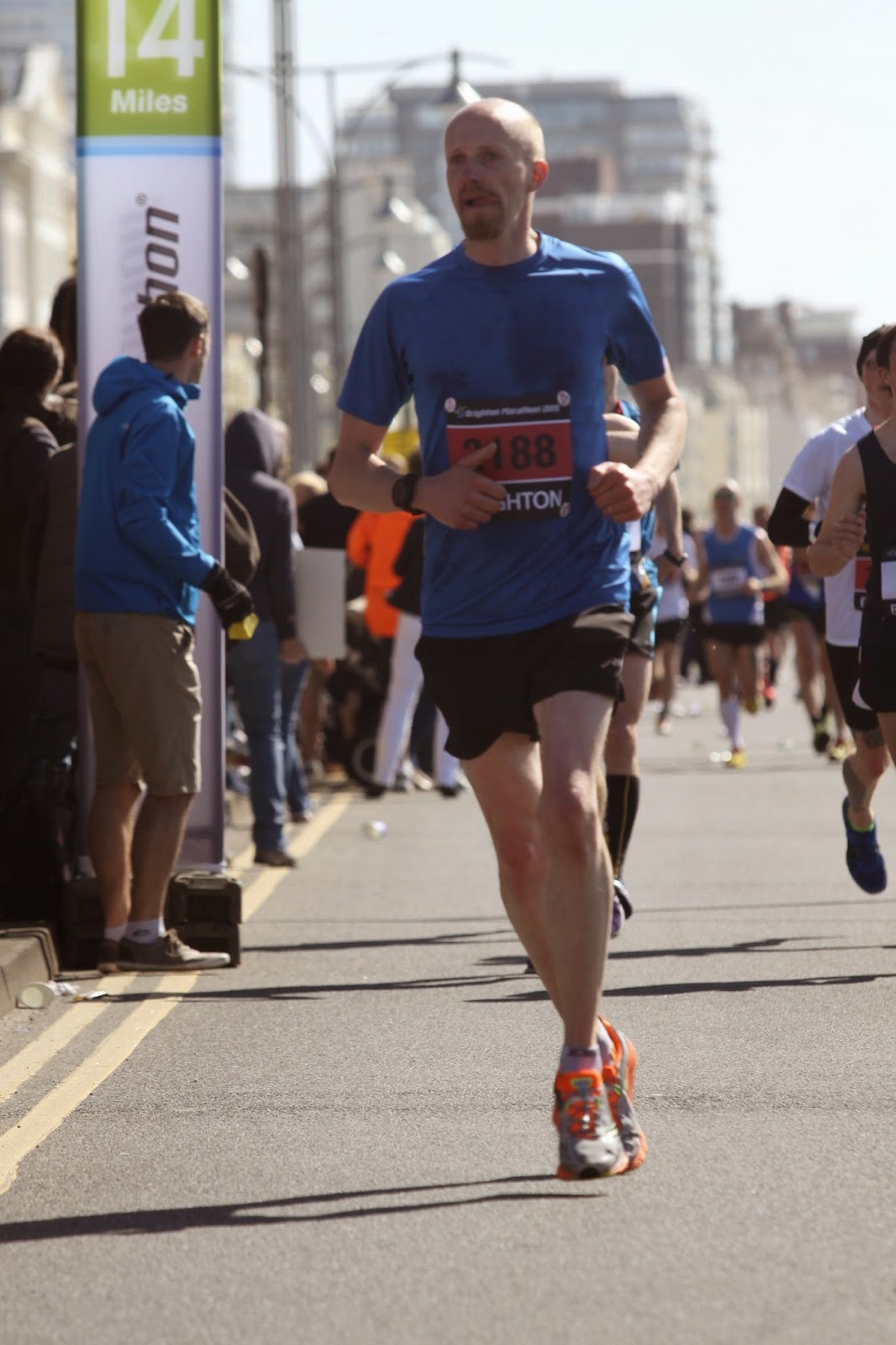
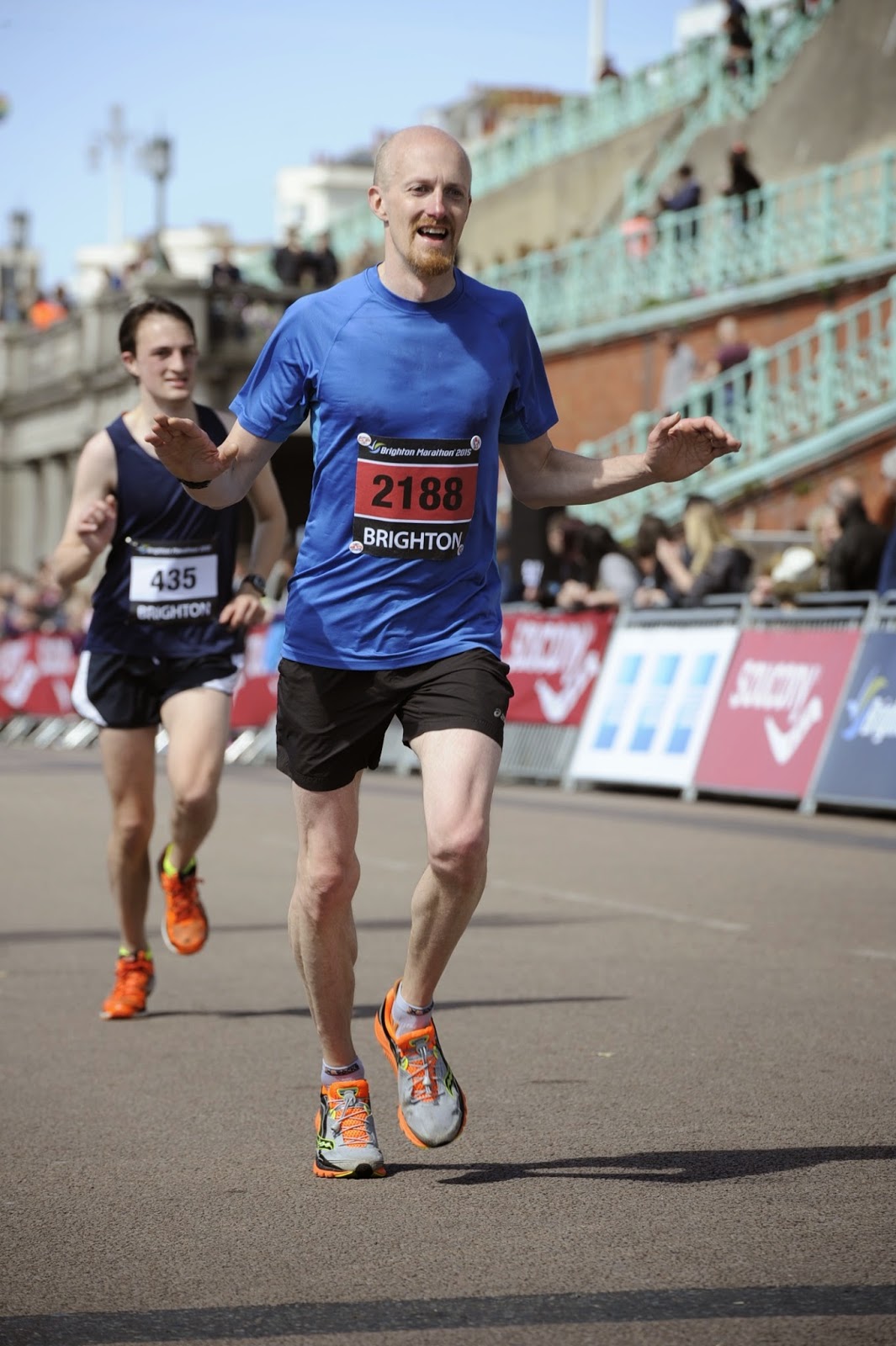
Fortunately by this time I'd made it back into Brighton and the cheering crowds along the seafront and promenade were a massive boost. If you look at some of the race photos, you can see me alternating between pained grimaces one minute and happy smiles the next.

Current pace had dropped to an average of 4:46/km (7:40/mile) for each of these last 3km. However, my watch was displaying an average race pace of 4:23/km (7:04/mile) so I knew I was on for a good time and I therefore didn't try to push any harder and risk a blown hamstring.

The finish

As the finish came into sight I tried to muster up everything I had for a final sprint, and I managed somewhere to pull out a 4:23/km pace for the final finish straight. I crossed the line with a huge smile on my face and a finishing time of 3 hours, 5 minutes and 19 seconds!

Yes, 3:05:19 for my first marathon. I was elated and not at all disappointed at missing that 3 hour mark. In fact by the time I'd reached back pick-up I was already planning my next marathon and how I would knock off those extra 5 and a bit minutes. It was also great to fire up the Brighton Marathon App and see that I finished in an amazing 160th position (165th on chip time), far higher up the standings than I ever thought was possible.

Recovery

I met up with my family and, as suggested by my sports masseur, I went and stood in the sea for 10 minutes to give my legs an early ice bath. It was then straight into compression tights and off for a nice meal to celebrate. Sunday evening and Monday morning were a bit painful as my legs started to stiffen up, but another ice bath and keeping active really helped. By Tuesday morning everything was feeling good again and with a couple of sessions on the foam roller I was out doing a 5k recovery run on the Thursday morning.

Race Assessment

So, I've finished my first marathon in a really good time, but I struggled at the end. My recent half marathon PBs suggest I could have gone faster, so what let me down?

Pacing

I did go out at a slightly faster pace in the first third than originally planned, but only by about 3 seconds per km. I also felt that I was running the first third at a relatively comfortable effort. By half way I was slightly up on where I had expected to be but spot on for a 3-hour time. All I needed to do was maintain a steady 4:15/km pace for the second half of the race. This should have been achievable based on my training and recent half marathon experiences.

I'm not sure whether I underestimated how tough the second half would be or whether the weather and hydration difficulties described below caused my pace to drop off, but I still think I'm capable of running the 4:15/km average pace for the entire distance.

Nutrition

I think I got my nutrition pretty much spot on. At no point did I feel depleted of energy and I certainly didn't hit the legendary 'wall'. After the race was complete I didn't experience any post-race energy dip or excessive tiredness so I think I must have got both my pre-race and in-race fuelling correct.

Hydration

It was hydration that I think really killed the final stages of the marathon for me. I found drinking from the paper cups far harder than I expected. I found that at most drink stations I spilt about half the water while trying to collect the cup and squeeze the top together into a funnel. This meant that I was probably only getting a couple of mouthfuls of water per drink station.

Given the weather conditions (see below) I think I was therefore loosing far more liquid than I was taking on board, even though I took a drink from every station. This certainly accounts for the gradual loss of performance in the later stages plus the early signs of muscle cramps in the last few km. I certainly wasn't unique in this situation as I saw so many people suffering during the last 10km, many having pulled up with cramp.

With hindsight I probably should have made the effort to slow down at the drink stations so as to not spill so much and therefore be able to get more water on board. Someone also mentioned in their post-race analysis that they got their wife to pass them drink bottles at a couple of points in the race. I'd never thought of that, but it's certainly an option that I will consider having available in the future.

Weather

Coupled with the difficulty I had taking on water, I think the weather conditions on the day contributed significantly to dehydration problems. It was a clear, sunny and warm day. However, the stiff sea breeze made it feel much cooler than it actually was. I think this resulted in a number of things happening:

  1. Extra effort was needed to run into the wind at a few points along the course. This resulted in more exertion that I didn't take account of in my pacing.
  2. The higher than expected temperatures and warm sun was causing more perspiration than expected (certainly much more than I'd been used to in any of my early morning training runs), but I didn't feel that I was getting hot at any point due to the cool breeze.
  3. The strong breeze was drying perspiration very quickly so it wasn't obvious just how much fluid I was loosing from sweating.

In all my previous races all I’ve needed to worry about was pacing in a head or tail wind or looking out for sunburn. This was the first race where weather had a significant impact on my performance and, given the length of the race, I needed to take it into account, but I didn’t do so successfully.

Learnings For Next Time

So, I’ve completed my first marathon in a really good time. I’ve got my good-for-age time for London in 2016 (unless they change the rules/requirements). What did I learn that I will do different next year?

Training plan adjustments

I was really happy with the P&D training plan that I followed. It seemed to work very well for me and the pacing discipline and strong scientific grounding really allowed me to have confidence in the plan.

The one change that I would make when using it again would be to add some additional marathon pace work and adjust when this occurs in the run.

First off I’d make sure that all of my long runs finish with a couple of kilometres at marathon pace. I feel that this would better prepare my legs for dealing with that last few km of the marathon when they are tired and when maintaining pace is essential for a fast time.

Additionally, in the plan there were a few marathon paced long runs, but I executed them as a short warm-up, marathon pace section and then the remainder of the long run at slow pace. When following the plan in future I will do all of the slow pace work first and then position the marathon pace work at the end. Again, the goal will be not to teach the legs to run a marathon pace (they can already do that) but to teach them to do it when they are tired.

Hydration strategy and practice

If the next race I do is planning to use paper cups for water I’ll be setting up a drinks station in my road and practicing and practicing until I can pick up cups and drink a decent amount from them without spillage! I really should have done that before Brighton but I just didn’t consider it such an issue.

I’m also certainly going to be going away and researching hydration strategies, fluid loss to perspiration and so forth. There are systems you can use whereby you weigh yourself before and after runs at different efforts and in different temperatures. From these it is possible to determine your expected rate of fluid loss and then use this as to plan and influence how much and how often you need to drink during a race. I plan to never go into a race again without having full certainty on how much fluid I need to consume.

Finally, if I have supporters coming along to cheer me on at my next marathon I will be making sure they are each armed with a disposable bottle of water with an added electrolyte tablet. That way if I’m struggling to take on enough water at drink stations I can always be sure that there will be a good alternative option available.

Strategy improvements

I still think my pacing strategy was reasonably sound and I think I followed it fairly successfully. However, for my next marathon I will aim to be much more precise with pacing in the early part of the race and not let myself get too carried away (even if it’s only by a few seconds per kilometre).

I’ve also learnt that as the distance of the race increases I need to take much more note of the weather conditions and adjust my expectations and pacing plan accordingly. In particular, I need to make sure I’m not over exerting into a headwind and getting the most from a tailwind rather than trying to maintain a consistent pace throughout.

The Next Marathon

Now that my first marathon is complete I’m already planning the next. Provided the rules don’t change I’ll be planning to exercise my good-for-age entry into the Virgin London Marathon in 2016. And I’ll be working really hard to get that sub 3-hour time on my next attempt.

Thursday, 16 April 2015

Journey to My First Marathon – Part 2

On 12th April 2015 I took part in Brighton Marathon, my first ever marathon event. In this series of four posts I will be talking about my marathon build-up, training, performance and what I learnt along the way.

In the first post I looked at how I selected Brighton Marathon and other build-up races and how I selected and customised my training plan.

In this post I'm going to cover my build-up to training, the execution of my training plan and the nutrition strategy that I adopted to take me through training.

Build Up

Unfortunately I picked up a tendonitis injury in my foot that put me out of action for much of September (too much running on the beach!). I knew that my training plan was starting in the second week of December and that it suggested I should be running 70km (45 miles) per week before I started it.

October and November were thus spent slowly increasing the number and length of runs starting at around 30km (20 miles) per week. I did all these runs very slowly at a pace of around 5:30/km (8:50/mile) so that heart rate was always kept well in the aerobic zone (130-141 bpm). It was tough to stick to, what for me, is a fairly slow pace, but I think building a strong aerobic base and allowing the foot to heal properly set me in really good stead for the training that came after.

By the end of November I was comfortably running 7 or 8 times (mainly to and from work) and covering around 70km each week. I was also maintaining one swim session per week. I was ready to start training in earnest...

Following the plan

The plan worked out really well. I managed to stay healthy and free of any major injury. This allowed me to train consistently for the whole 18 weeks. In fact, I didn't miss a single session which I think really helped with being in top form. I also managed to keep a 100% score on Jantastic as well!

Luckily the only small niggle that I picked up was a tight achilles on my left leg. This was primarily linked to very tight calf muscles in my left leg. As long as I kept these well stretched and mobile then the achilles didn't really hamper my training.

There's no doubt that the plan was tough. In particular the presence of a medium-long run (16-19km / 10-12 miles) each week in addition to a long run meant that most sessions were done on fairly tired legs. Also, most beginner marathon plans I've seen tend to build up to just one or two very long runs (27km/17 mile+) at the end, while the P&D plan had me doing 9 very long runs over the 18 weeks of the plan.

I did find that about half way through the 18 weeks I had to change the plan slightly. On four days each week I was running to work as a session and then doing a short (3.5km) recovery run home again. As the main runs got longer and harder I decided that this was resulting in too much running. So, I dropped the second runs on Monday and Friday and cycled to work instead on those days. This certainly aided recovery and freshness and I don't think I could have completed the plan as successfully without making this change.

Focus of the plan

The P&D plans don't focus very much on speed work, assuming that the speed is already there and that you just want to increase endurance and the ability to maintain that speed over a longer period of time. This was just fine for me, although I did find that as my fitness improved my threshold pace was also getting faster as well.

The other thing that the plan is quite light on is actual marathon pace work. I think there were only about three or four sessions that had any marathon pace elements scheduled and even these were only partial sections of a longer run. The core plan was primarily about long and medium slow runs, general aerobic conditioning, lactate threshold runs and then, towards the end, some VO2 max work as well. I'll touch on this further in the final post where I review what I've learnt.

Pacing and heart rate

The P&D plan structures all of its sessions based on heart rate zones: starting with a heart rate reserve (max HR – resting HR) and then defining training zones based on that reserve. These work out as follows (with my max HR as 186 and resting HR at 56):

  • Recovery: less than 70% of reserve + resting HR = below 147 bpm
  • General Aerobic: 62% to 75% of reserve + resting HR = 136 to 153 bpm
  • Medium/Long Run: 65% to 78% of reserve + resting HR = 140 to 157 bpm
  • Marathon Pace: 73% to 84% of reserve + resting HR = 150 to 165 bpm
  • Lactate Threshold: 77% to 88% of reserve + resting HR = 156 to 170 bpm
  • VO2 Max: 91% to 94% of reserve + resting HR = 174 to 178 bpm

I pretty much stuck to these zones for all my training on the plan. On a typical day these heart rates translated to roughly the following paces:

  • Recovery: 5:30/km (8:35/mile)
  • General Aerobic: about 5:15/km (8:17/mile)
  • Medium/Long Run: about 5:08/km (8:00/mile)
  • Marathon Pace: about 4:24/km (7:05/mile)
  • Lactate Threshold: about 4:05/km (6:35/mile)
  • VO2 Max: about 3:50/km (6:10/mile)

Lactate Threshold pace in particular improved from about 4:10/km at the start of the training to 3:58/km that I maintained at Reading Half Marathon.

Mental Discipline

It was however surprisingly difficult to maintain the required heart rate zones and paces. On a good day it was really tempting to go a bit faster. On a bad day it was a real challenge summing up enough pace to get into the required heart rate zone. On a really bad day, trying to keep in the heart rate zone and a good pace at the same time was almost impossible. Still, the end results seem to have been good so it was certainly worth the hard work that this involved.

I also think that the mental concentration required to maintain both pace and heart rate was excellent preparation for race conditions. As it's impossible to run and continually look at a watch, I developed a very good feel for both how fast I was travelling and my current level of exertion. Add to that being able to concentrate on these aspects of running this for long periods of time and you have most of the mental skills in place for a longer duration race like a marathon.

Equipment

With all of my training taking place within defined heart rate zones, having the right equipment was essential. First off, every single run involved use of a heart rate monitor chest strap. I'm quite lucky that I don't suffer any discomfort from these, but getting one that is really comfortable makes a big difference. Secondly a really decent GPS running watch that supports heart rate zone training is also a very worthwhile investment.

The first few weeks of training were carried out with my trusty iPhone running the iSmoothRun App and my Pebble smartwatch for display purposes. Fortunately I was the recipient of a Suunto Ambit3 watch for Christmas and this made the rest of the training programme a much more enjoyable experience. Just running without a slab of glass strapped round your arm was a huge win. I tend to run without any music, so needing nothing other than a watch and the HRM strap was great.

Shoes

I used a number of different shoes during training. Most of my general and longer runs were done in Saucony Echelon 3. These are a great neutral shoe with a reasonable amount of cushioning. I also did plenty of other runs in my Saucony Peregrine 4 trail shoes, especially when my off-road routes started to get a bit wet and muddy. All of my faster sessions were carried out in Saucony Kinvara 4, swapping to a pair of Kinvara 5 towards the end as these are a very lightweight shoe that are great for going fast in! I used the Kinvara 5 for all my races as well, including the marathon.

Nutrition

Back at the beginning of 2014 I swapped from a typical UK diet to more of a paleo style diet. This involved reducing carbohydrate intake, increasing protein intake and swapping to less processed and sugary foods that are high in natural fats. In particular my meals changed to:

  • Breakfast: cereal and fruit juice became half a grapefruit, salad, poached eggs, avocado and water.
  • Morning snack: remained as cheese and a cracker
  • Lunch: sandwiches and a low-fat yoghurt became roasted veg, sweet potato, smoked mackerel and a full-fat yoghurt.
  • Afternoon snack: fruit, dates, peanut/almond butter and oat cakes replaced biscuits or cake.
  • Dinner: normal meals but mostly eliminating high-carb items like pasta, pizza, bread and potatoes.
  • Evening snack: milk and dark chocolate.
  • Drinks: black tea, coffee and significantly more water (I was already teetotal).

Supplements

The only supplement that I take is Zinc Matrix, which I have found really helps with keeping hormone levels in balance and aids recovery while sleeping. Since taking these tablets before bed I've certainly noticed better quality sleep and waking up much fresher in the morning. Other than the Zinc Matrix, all my other nutrition needs are taken care of by a healthy diet.

Impact on health and performance

I credit a change in diet to significant improvements in my running ability. I've found it much easier to keep my weight under control and maintain a very lean physique. I certainly didn't find myself lacking for energy during any part of the training.

The fact that I didn't have any illness throughout the training period is probably also down to eating very healthily. There also appears to be a strong link between eating sufficient protein and quality fats and the body's ability to recover and repair injury. Again, I think my diet definitely helped keep me injury free and able to put the maximum into my training.

Fuelling for training runs

The vast majority of my training runs all took place first thing in the morning, even the long runs. For a General Aerobic, Lactate Threshold or VO2 Max session I would generally get up, have a glass of water and then head straight out. For my long and medium-long runs I'd typically get up and have half a grapefruit and perhaps a banana with my water. Breakfast would be consumed after returning from the run.

I firmly believe that doing most of my training in a largely fasted state combined with changing my diet has significantly improved my fat burning ability and allows me to run quite efficiently without needing to injest large amounts of carbohydrates. I'll revisit this assumption in the next parts of this series when I look at my race preparation and performance.

As most of my runs were done very early and on cold, dark mornings I found very little need to drink much during training. It was only really on the long 28km (16 mile) plus runs that I bothered with any water. Even for those all I did was place a couple of small bottles of water on my route at the 1/3 and 2/3 distances. A few sips was generally enough in most cases.

On my long runs I also consumed energy gels following the same pattern that I intended to adopt during the marathon. I've never really been a big fan of the maltodextrin based gels and they certainly don't work well with my paleo style diet. Instead I've switched over to 33Shake chia seed based gels. These are much more natural and provide a much slower release of energy as opposed to the massive sugar hit of normal gels.

During long runs I would generally consume gels at 8k, 16k and 24k and this was sufficient to see me to the end of the run. Included in the post-long-run breakfast I also had a 33Shake All In One Shake as part of my refuel and recovery routine. I found their nutrition worked really well and was very compatible with my dietary needs.

Getting Ready to Race

With the training plan going well and a healthy diet in place it was time to start preparing for the big race. This will be the subject of the next post in this series.

Journey to My First Marathon – Part 1

On 12th April 2015 I took part in Brighton Marathon, my first ever marathon event. In this series of four posts I will be talking about my marathon build-up, training, performance and what I learnt along the way.

In this first post I'm going to look at how I selected Brighton Marathon and other build-up races and how I selected and customised my training plan.

Race Selection

After a successful Reading Half Marathon in 2014 I decided that I wanted to attempt a marathon in 2015. Looking around for a spring event of a decent size and convenient date I narrowed down the choice to either London or Brighton. Not wanting to chance my marathon debut on a ballot, and the fact that we like visiting Brighton, made it a fairly easy decision.

Also, based on my 2014 Reading Half time of 1:30:01 I was also fairly confident to predict a marathon time of about 3:10:00 which, if achieved, would get me a good-for-age entry into London for 2016 anyway.

So, at the end of May 2014 I booked my place for Brighton. At the same time I also booked a hotel for a family long-weekend holiday (Friday to Monday). My logic at the time was that I didn't want to chance travelling down on the Saturday and missing the race number collection and I wasn't sure what state I would be in on the Sunday afternoon to drive home again. As it was, I would have been fine on both counts, but it was nice to have a family weekend away!

Build-Up Races

With my main race for 2015 booked, I then decided to look around for a half marathon in the weeks before. The aim being to use this race to test my fitness and practice race strategy. My default selection was to do Reading as this is my local race and a race I've always enjoyed previously.

However, when the date for Reading was released I discovered that it was only three weeks before Brighton. A few questions on some forums and the suggestion was that this wasn't my best option, the main reasons being:

  • With the race being right before the taper there would be little time to adjust training or strategy before the marathon date.
  • If I was carrying any niggles and aggravated them during the race, three weeks might not be long enough to allow them to heal.

I then looked around for something a bit earlier in the season and came across Bath Half. This was six weeks before Brighton and marked as a fast, fairly flat course. I therefore signed up for Bath as well. The aim being to do Bath as a full-on effort, aiming for a new PB for a half marathon. Reading would be a marathon pace training run and race practice, with the option of running it as a full race effort if things were going well with my training.

My race calendar for the start of 2015 was now complete. I then went away to focus on triathlon for the summer.

Training Plan Selection

For my first half marathon I followed a basic plan straight out of the pages of Runners World. As I started to read and learn more about running I then switched to building my own custom plans using various books and online sources as inspiration. However, for my first marathon I decided that it was important to follow a proper structured plan. I wanted one with a sound scientific background and a proven track record.

Finding a plan

Listening to the Marathon Talk podcast I had heard quite a bit about the Pfitzinger and Douglas plans and their book Advanced Marathoning. I purchased a copy, read it cover-to-cover and was very impressed by their approach.

I have a strong belief that a training plan will only be really effective if you believe in it. As someone with a scientific and highly logical background I was far more comfortable knowing the full reasoning behind the plan structure and recommended sessions. I just can't see myself ever being confident with plans that just tell you what sessions you need to do and when without giving you the full understanding of why.

With an understanding of and confidence in their approach to marathoning, I decided to select the Pfitzinger & Douglas 18-week 'up-to 55 miles per week' training plan. This felt compatible with my limited running history, my current mileage and the number of hours that I could dedicate to training each week.

Customising the plan

The first step was then to customise the plan to fit into my slightly unusual circumstances. I had the following constraints to meet:

  • No training runs at weekends, except short sessions on a Sunday evening (part of my agreement to enter the marathon would be that training shouldn't impact on family time).
  • Avoid training in the evenings during the week (for the same family time reasons and because my wife uses evenings for exercise classes and activities).
  • Maintain one swimming session each week, which has to be on a Wednesday or Friday morning as that's the only time when the pool has convenient adult lane sessions. This was necessary as I was planning on some triathlons later in 2015.

With the above constraints in mind, I re-jigged the P&D plan so that it roughly fit the following pattern:

  • Monday morning – general aerobic run
  • Tuesday morning – long run
  • Wednesday morning – swimming
  • Thursday morning – medium-long run
  • Friday morning – session (e.g. lactate threshold, intervals)
  • Saturday – rest day or slow recovery run with the kids (working up to Parkrun)
  • Sunday evening – easy recovery run

This would mean doing some 3 hour runs on a Tuesday morning before work, but the plan fit my schedule nicely and getting up early has never really been much of a problem for me.

I also planned on making the runs on Monday, Tuesday, Thursday and Friday morning end at work so that I could do a 3.5km (2 mile) recovery run home each evening.

In addition to the running, I also scheduled in a core strength session every Tuesday evening and a leg and hip strength session on a Friday or Saturday evening. Also there were short sessions of stretching and rolling pretty much every night as well.

Ready to Go

With a plan in place it was time to start my build-up and then move on to the training plan proper. These will be the subject of my next post in this series.

Monday, 9 March 2015

What I Want From an Online Training and Activity Tracking Tool

Someone in our local Facebook running group recently asked members to complete a survey on how they track, record and share their running. This got me thinking about what sites and service I currently use and what features would be required for me to swap them all for a single unifying solution.

Primary Tools and Services

First off, it's worth looking at what I currently use and what features are good and lacking in each service. My current activity tracking and training platform consists of four fairly disjointed websites and services:

Movescount

I use a Suunto Ambit3 multi-sport watch to track all my activities. It's a superb watch (I'll add a separate review later) and it synchronises to Suunto's proprietary Movescount site and app. Movescount is essential in the mix as you need it to get data off the watch, configure activities and update the settings on the watch. Additionally it has a pretty neat app designer for building your own watch apps (as a software engineer this is something I'm using quite a lot).

Also, it has a reasonable training planner feature that syncs with the Ambit3 so you can always find out what your workouts for the day should be without needing to be near a computer or mobile. Unfortunately this planner isn't the easiest to use for actually building a plan and it doesn't work particularly well as a training diary, so I also have to maintain this data elsewhere as well and keep the two in sync manually.

Analysis of activity data is fairly rudimentary, probably just the minimum subset of features you can get away with. There's fairly good data about individual activities, but there's no way to track trends across multiple activities or periods. Fortunately the Movescount site can be configured to automatically export to Strava and TrainingPeaks, and you can also download .fit or .gpx files for manual import into other sites.

The community aspects of Movescount are quite limited, mainly because it's comprised only of Suunto owners.

Strava

I switched over from Runkeeper to Strava about 18 months ago. It's one of the two sites that I actually pay to use the premium services. Most of my individual activity analysis is done on Strava and this is also the place that I use to track shoe usage figures and to plan routes. I like the features that they have for analysing running and bike data. However, as a triathlete, I wish they did a better job on swim analysis.

The recent expansion to start tracking trends across similar runs/rides is nice, but this functionality is still very lacking in it's scope. You can't use it for any serious performance over time analysis as it appears to be only based on following the same identical routes each time, which gets rather boring.

I like the Strava training log and calendar feature, but not being able to use it as a training planner is a real weakness in my mind. Also, Strava doesn't really function that well as a training diary as you can only attach limited information to individual activities and there's no real publishing/sharing mechanism.

However, the biggest value I get from Strava, beyond the activity tracking, is the community aspect. Being able to join clubs, link to races and follow other athletes is great. I've been able to meet some great people and share in experiences and discussions. Being able to send and receive kudos and comment on activities just makes at all a bit more special. After doing a particularly awesome but tough session or race, getting some virtual high-fives is a really nice feeling.

TrainingPeaks

I've been looking for a good training planner/diary tool for a long, long time. I even started writing my own at one point (but work got in the way of finishing it!). First I came across XHale (see below) but it's limited feature set and manual event import weren't working for me. Then I decided to experiment with TrainingPeaks and I've been using it happily for a few weeks. This is the other tool that I now actually pay for the Premium Edition.

The main feature that I use within TrainingPeaks is the Calendar functionality. I use it as an additional activity tracker (in addition to Strava), with activities being automatically synchronised from Movescount. I also use the Calendar functionality to build my future training plans. It's a great plan builder and has good support for libraries of workouts and moving activities around. The ability to expose the Calendar as an iCal feed and also work with it in the dedicated TrainingPeaks iOS app are really useful as well.

In addition to using the Calendar to plan and record workouts, it also acts are a reasonably good training diary. You can record pre and post-activity notes and details of how the session went. There's also pretty good support for adding metrics like sleep, weight, mood, motivation, steps and so on into the Calendar.

Probably the only major features that seem to be missing from the Calendar are the ability to record notes and goals against weeks or training meso-cycles as opposed to individual activities (I think the classic view supports this to some extent, but it's not yet present on the new view) and the ability to publish a summary of my training diary to a blog. It would also be really nice if the TrainingPeaks app was HealthKit integrated so that it could automatically populate metrics into the calendar from the other apps that I use to capture this info already (SleepCycle, Nudge, MyFitnessPal, manually entered weight etc.)

The other parts of TrainingPeaks that I make good use of are its ability to define Annual Training Plans (which help with training plan building) and the Dashboard. On the Dashboard, the Performance Manager is by far the best component in terms of assessing ongoing levels of training load and stress in order to get the right balance between training enough to get improvements versus over-training. Being able to add custom charts and graphs to the visiualisation on the Dashboard is also a great feature.

Blogger

I maintain two blogs, one about software development and another about running and triathlon (this one in fact!). I do these via the free Blogger platform, mainly because I can't be bothered with the hassle of administering anything myself! My blog entries tend to be just observations, thoughts or reviews.

I don't record a training diary on my blog mainly because, again, I can't be bothered with all the pain of exporting and duplicating the information from Strava/TrainingPeaks into yet another location. I make do with the minimalist Strava activity summary and activity feed blog widgets.

Other Tools and Services

There are some other tools and services that complete my platform or that I found useful but stopped using for one reason or another.

Facebook

Unfortunately I can't avoid Facebook as most of my friends and family are on there. I usually share major runs or important races from Strava on to Facebook so that all my non-running contacts can see what I've achieved.

Twitter

I don't normally tweet all my runs as I find that frustrating when other people clog up my feed with that level of noise. I do tend to announce any new blog posts that I write via a Twitter post as I know a good proportion of my followers will find them of interest.

XHale

A few months ago I started using Xhale as my training planner and diary. It's pretty good for a free tool. Unfortunately it has very minimal ability for analysis, limited import functionality (I was exporting .fit files from Movescount and manually uploading them) and it also doesn't provide any way to export or expose the training diary. These are the main reasons I swapped to TrainingPeaks. It also doesn't provide any way to publish the training diary to a blog. It does what it does well, but it's yet another location to visit rather than a unifying point for my data.

Smashrun

I only came across this new site a few days ago. I've uploaded a few runs and so far it looks promising. What I do like so far is that their focus seems to be on detailed analysis of individual runs plus also trends over time. If they get the trend analysis right then they will have a real differentiator in the market.

Downsides seem to be at the moment that they only track runs (not other activity types like bike or swim), they have limited sync capabilities (so data import is manual TCX files for me), and there is no training planner / diary support. Still early days, but I will continue to watch this one, although not actively use it for the time being.

Swim.com

I was using swim.com with my Pebble watch to track and analyse my swimming sessions. I found their service very useful and the analysis features were nicely optimised for swimming. Unfortunately they don't support or plan sync for Suunto devices and they only seem to be able to handle Garmin specific FIT files.

I therefore don't use their site any more and I haven't yet found anything as good for analysis of swimming data.

iSmoothRun

Before I got my Ambit 3, my main activity tracking was via the iSmoothRun app on my iPhone. This is by far the best app on the market and has a huge amount of configuration and export options. It also has great support for audio cues, interval sessions and so forth. Having a dedicated GPS watch is much nicer, but I do miss many of the iSmoothRun features.

What I'm Looking For

Basically, I want it all! However, at the minimum, I'm after something that:

  1. Allows me to upload, comment on, tag and analyse (in detail) individual activities (must support: run, bike and swim, plus multi-sport events like duathlons and triathlons)
  2. Identifies and presents me with performance, fitness and training load trends over time for different types of activities, sessions and metrics
  3. Provides a training planner tool that easily allows me to build and modify my plan
  4. Provides a diary so that I can review sessions, comment on how sessions went, link activities to sessions, comment on weekly and other training cycles, define and track goals, and track usage of shoes and bikes
  5. Support for capturing and analysing other metrics (e.g. sleep, body measurements, food intake, hydration, mood, motivation, injury etc.)
  6. Route planning and sharing
  7. Allow me to write blog entries and then publish my training diary, activities and blog entries to a single common page
  8. Allow me to share content via Facebook and Twitter
  9. Have a community element where I can join clubs and events, follow other user's activity feeds, diary and blogs, give them a virtual high-five and comment on their content

Secondary features that I would like to see include:

  1. The ability to sync activities directly with Movescount so that they are automatically added just by syncing my watch (but I guess this is Suunto dependent)
  2. The ability to sync my training plan with Movescount so that upcoming activities are always available on my watch (again, probably Suunto dependent)
  3. The ability to customise and extend the data and trend analysis platform so that I can define my own additional metrics to track and which activities to include, display custom graphs of and so forth
  4. Support for a wider range of activities that can be tracked (e.g. mountaing biking, hiking, yoga, pilates, strength, stretching, spin, skiiing, football etc.)
  5. The ability to expose my training calendar using standard calendar exchange formats so that I can view my training plan from the Calendar application on my phone/laptop
  6. An iOS app so that I can see, update and publish my training calendar and diary on the move
  7. HealthKit integration on iOS so that metrics that I capture from other apps are automatically synced into my training diary
  8. An open API, so that I (or other devs) can write our own tools, apps and site integrations on top of an open service/data platform
  9. The ability to have a coach account so that (when I can finally afford a coach) they can build training plans for me, review my session stats and diary entries, add their own comments and track the long-term trends associated with my performance, so that they can continually improve my training plan

That's a lot to ask of a platform and its a very crowded market place to be entering. However, I'm currently playing for two services, each of which does part of what I'm after, but even together not the whole. I would certainly pay for a platform that meets even just my primary requirements (provide it's not too expensive – ideally less than £120 per year [5% of my training, kit and race entry budget]). I would hope that there is a significantly large body of athletes with similar requirements to me in order to make it viable.

Wednesday, 4 March 2015

Plans and Specificity

I'm currently training for Brighton Marathon in April, and following the Pfitzinger and Douglas 'up-to-55-miles per week' training plan. There's no denying that the plan is tough, especially completing both a long (up to 20 miles) plus a medium-long (up to 14 miles) run each week. However, I'm finishing the long runs feeling strong and that's giving me a lot of confidence for what will be my first ever marathon.

Chatting about training plans on a forum, someone mentioned that they weren't keen on the P&D plans as they don't include a large amount of speed work sessions. They are correct: most of the sessions are focussed towards endurance and marathon pace work. However, to my mind that's why I picked this plan. I'm not currently looking towards building speed and going faster.

This got me thinking about specificity of training. My goal is very specific: take my existing 5K/10K/HM pace and scale it up so that I can maintain the same level of performance over the marathon distance. To achieve this requires endurance and longer distance marathon pace work: exactly what the P&D plan offers.

If I want to run faster, I'm not going to try to achieve this as part of a marathon training programme. I'd first be looking to scale back and focus on improving my speed over the 5K-10K distance as these are more speed-specific distances. My training would be specific to these events: more intense VO2 Max and interval sessions, more threshold runs. Then, once I've locked in these speed improvements into my general running, I'd then be looking to switch back to a plan focussed on endurance and allowing me to apply these new performance gains over longer distances.

My take-away from this is that when your training time is limited, trying to improve multiple performance aspects at the same time just isn't going to work. You'll just get mediocre improvements across the board. Instead, work out what your main priority is and build a plan specific to that goal. When that goal is complete then is the time to decide if you want to change the focus. If so, build a plan specific to the new objective.

Wednesday, 25 June 2014

My Next 10-Day Training Cycle

In this post I talked about switching from a 7-day training cycle to a 10-day one. Then in this follow-up post I talked about how that worked out for me. I'm now on my next training plan and I've decided to stick with the 10-day cycle length.

Objectives

My current training objective is my first ever triathlon (Newbury Triathlon) on 7th September. This is a nice introductory sprint event with a 400m pool swim, 22k bike and 5k run. The pool based swim is good for me as this is by far my weakest discipline and the most difficult one to train.

Following that I have Basingstoke Half Marathon at the beginning of October. This is an undulating course, so I'm trying to keep a running heavy plan with enough hill work.

Situation

Since the last plan I built I've had a change of jobs and I'm now working at a company just 2.2 miles from home. This means I have plenty of scope for run-commuting, bike-commuting or fitting in an early morning swim session. I can now make all my local leisure centre's early lane sessions (Monday, Wednesday and Friday), which made building the new plan much easier.

Requirements

The new plan covers 12 weeks, divided as eight 10-day cycles and a short 4-day taper leading up to race day. For each cycle my objective is to include the following sessions:

  • Running: long run
  • Running: intervals session
  • Running: tempo or hills session, alternating each cycle
  • [Running: easy recovery runs home from work as required]
  • Bike: long ride
  • Bike: sprint session
  • Bike: short ride (usually to and from 5-a-side football)
  • [Bike: easy recovery rides home from work as required]
  • Swim: long steady swim
  • Swim: sets
  • Strength & Flexibility: 2 sessions

This looks like a lot of sessions to fit in to 10 days, but bear in mind that if I run or bike to work then those days automatically include the recovery session to get home again.

The other challenge with this plan is that I have three holidays to fit in (one full week and two long weekends). During these I won't have access to a swimming pool or a bike so they have to be largely running based periods.

The New Plan

So, the final plan is shown below. Colour scheme is: pink - strength/flexibility, purple - run, green - bike, blue - swim, light yellow - other sports, grey - holiday, yellow - triathlon specific training, cyan - rest day.

Conclusion

So, you can see that everything fits together pretty well. I've got (just about) enough rest days and I've managed to be flexible around holiday periods. There's also some scope in there to swap things around as needed.

Overall, the 10-day cycle training plan has worked out really well. I was expecting it to be less easy to build given the amount of sessions I'm trying to fit in. I was plesently surprised and I'm happy to commit to continuing with the 10-day approach beyond this plan.

Wednesday, 7 May 2014

10 Day Training Cycle Update

In this post I talked about my experiment to switch from a 7-day weekly cycle to a 10-day version. This is the follow-up post describing the results.

Background

So, I've now been on a 10-day cycle training plan for just over two months. I started with an initial plan of four cycles, covering a period of just under six weeks. I'm now about half way through a second four cycle block leading to a 10K running race at the end of May.

In September I'm competing in my first triathlong, so my plan as been about laying down the groundwork in swimming and cycling while building up to peak 10K running fitness.

In my previous post I described how I went about building the plan. In the remainder of this post I want to talk about how the plan actually worked out for me and changes that might be needed.

Sticking to the Plan

I actually found keeping to the plan was very easy in the most part. This was probably because I built the sessions around the periods that I knew I would have time to train. That made building the plan more challenging, but following it much easier. Had I built the perfect plan then tried to arrange my life around the training then I suspect it would have been much more challenging.

However, towards the end of the first block of cycles I picked up a small running niggle and at around the same time my work situation changed. This threw the plan into some chaos and required I make some fairly significant changes to the sessions.

Flexibility of the Plan

Given the challenges I faced building a 10-day plan in the first place, I expected that making session adjustments would be difficult. However, I was pleasently surprised how easy it was to change. Some running sessions had to switch to slow recovery runs and I had to dump some runs and put a bit more swimming in to replace them.

Adding swimming was the most challenging part of building the plan as there is a double constraint involved: the need to match both the time I can train and the times my local pool has lane sessions. However, the fact that a 10-day cycle is much more spread out than a 7-day one means moving slots around is much more achievable. I think this was a big win for the 10-day cycle approach and not something that I was expecting.

Frequency of Sessions

When I built the plan my goal was to include one swim session, one long bike session and one running interval session in each 10-day block. The rest would be filled with slower runs and strength sessions. Some blocks had an extra bike session if space was available.

What I discovered when executing the plan, however, was that only one swim session and one interval run session every 10+ days wasn't enough. The longer gap between the sessions was hampering my ability to improve consistently. I found that to get the improvement that I was expecting I had to swim at least once each week and interval sessions needed no more than 7 days gap between them.

In practice this means having 2 swims and 2 interval sessions in each 10-day cycle block, which then tends to crowd out other sessions. Or, having interdependencies between cycles, which makes planning way more difficult. I haven't managed to solve this challenge yet and if I stick with a 10-day cycle I will be trying to address this in my next planning block.

Fitting into My Work/Life Schedule

The other challenge that I found with a 10-day cycle is that my life is inherently structured around a weekly schedule: the swimming pool lane sessions that are compatible with my work schedule only happen on two days each week; various activities with the children happen at the same time each week; work follows a stict Monday to Friday schedule and so on.

What I therefore found as I adapted the first plan and started building the second plan is that certain sessions ending up having to be placed in exactly the same slot each week and then the remaining sessions positioned around them. The result is that I would often end up with two quite intense sessions very close together or two important sessions (like the long run) a wide distance apart. I found this very challenging for building consistency in my training.

Conclusion

I found the 10-day cycle training plan to work quite well and I was surprised that it was much more flexible than I was expecting. The less crowded plan was certainly welcome on busy weeks. However, the problem with getting the correct frequency of certain key sessions and fitting the plan around a life that is structured weekly are particular challenges for this approach.

For my next block of training I will be planning both 7-day and 10-day cycles and I will see which works out best with my new job. Given the need to swim more frequently, I think the 7-day approach may win purely down to the very restricted lane swimming times at my local pool.

Friday, 28 February 2014

10-Day Training Cycles

This week on the Kinetic Revolution Podcast there was an excellent interview with Gary Reynolds of Runners Paradise. The subject was on training cycle length and how we tend to focus on a 7-day cycle (because that's how long a week is), when in fact other lengths, such as a 10-day cycle might be more appropriate.

This talk about training cycles couldn't have come at a better time. I was right in the middle of building a rather full-to-bursting weekly plan which I have now adapted into a much better spaced 10-day alternative. I thought I'd share my experience as evidence that this approach really can work.

The Plan Contents

As background: I'm just coming off a 12 week plan that I built myself in preparation for Reading Half Marathon this weekend. The plan was a 7-day one, consisting of 5 run sessions, 2 strength/flexibility sessions and 1 rest day. It has gone very well and all that remains now is seeing how well I perform on Sunday.

I've now got 12 weeks until my next race, which is my local 10K. This is really a 'B' race for me, so I thought it a good point to introduce a 6 week core aerobic, strength and flexibility cycle while still keeping my eye on a good 10k performance. In addition to this I'm doing my first ever triathlon in September (just a short sprint one) so I though this would also be a good point to start introducing some swimming and bike work as well.

In each cycle I'm therefore aiming to fit in the following sessions:

  • A long run of around 10 miles
  • An easy 10K run
  • A run speed session (tempo, hills or intervals) just to maintain form for the 10K
  • A long(ish) bike ride of around 1hr 30mins - 2 hours
  • A shorter bike ride
  • A swimming session of about an hour
  • Two strength and flexibility sessions
  • A weekly game of five-a-side football (as this helps break up my movement patterns)

A 7-Day Cycle Plan

My initial attempt was to squeeze this into my normal weekly template, but it ended up being VERY crowded, to the point where a Thursday would end up being a long bike ride in the morning and then a 5K easy run at lunchtime; Tuesday would have two big workout sessions; and Wednesday swimming would be a late 9pm-10pm session (local pool lane time), followed by a 6am start on Thursday morning to fit in the bike session before work - not ideal! This initial draft is shown below. The colour code is: Red - running, Green - bike, Blue - swim, Yellow - gym work. Five-a-side football is always on a Sunday evening.

I really wasn't happy with this plan as it felt almost like overtraining in what should actually be a more relaxed period between two heavy, race focused ones. The idea of a 10-day cycle was therefore very appealing.

I was initially somewhat sceptical as to how my sessions would fit into a 10-day plan. My training times have LOTS of restrictions on them, including:

  • I try to avoid training in the evenings where possible (other than strength and flexibility work which I do at home) due to child care, charity work and making sure my wife has time for her workouts and events.
  • Weekends are family time, so have no training booked against them until the kids are in bed at the end of the day.
  • Sunday evening is five-a-side football.
  • Monday, Tuesday and Wednesday I have a 5:15am start in order to get to work so I normally restrict myself to getting up at 4:30am on only one of these days in order to get a session in first. Any more would be too tiring.
  • Thursday and Friday I work from home so these are the only days I can really fit in any long sessions (usually by getting up early and doing them before starting work).
  • Evening adult lane sessions at my local pool are 9pm-10pm, which is a bit too late for me given my early morning starts.

A 10-Day Cycle Plan

So, what I did is allowed a couple of days recovery from Reading Half Marathon and then broke my six weeks down into four 10-day blocks (instead of six 1-week ones). I then fitted in the sessions that were immovable, such as five-a-side football on a Sunday (which I will cycle to and from) and the long sessions that have to take place on a Thursday or Friday morning. I then fitted the rest of the sessions around this starting point, particularly trying to avoid late evening swimming if possible (which I managed on all but one day).

The net result is that over the six weeks I'm getting less of each type of session in (4 of each instead of 6 of each) but it feels much more relaxed. There are virtually no doubling up days and the number of rest days is the same as the 7-day plan. The training commitment fits better with family life and, being less exhausting, means I will be able to focus more intently on session quality rather than quantity.

So, here’s the plan adjusted to a 10-day cycle. Colour scheme is still: Red - running, Green - bike, Blue - swim, Yellow - gym work and black blocks just mark out the 10-day windows.

All-in-all, it looks and feels like a much more sustainable plan, which will be less exhausting and thus (hopefully) less chance of injury. The big open question I do have is to how amenable it will be to last minute schedule changes, such as a late meeting, which might result in having to move a few sessions around. I’ll report back in six weeks as to how well it worked out.