Showing posts with label running. Show all posts

Tuesday, 25 July 2017

Outlaw Triathlon - Part 3 - My Race Performance

This is one of a three part set of posts about my first iron distance triathlon: Outlaw Triathlon 2017. This post contains the analysis of my race performance. You can also read about my training and my review of the event.

In this final post in my series on the Outlaw Triathlon I want to review my performance, look at what I learnt and how to improve if (when) I do another event of this distance in the future.

Context

Prior to this event I'd never done an iron distance triathlon before. In fact, apart from the middle distance event I did in the build up, the longest I'd gone before was an olympic distance tri. I'd also previously run two marathons, including a 2:59:34 at London in 2016.

I've already covered training in another post in this series and felt that I was going into the race in the best possible shape that I could be. No injuries or niggles. Calves felt a fraction tight, but I find that's quite common for me after a taper period.

The Swim

I've been working really hard on my swim in the build up. Made some huge improvements. Prior to starting the training plan the longest I had ever swum in one go was 2.4km. Target pace was 2:00/100m that I'd been practising in training.

The main thing I don't like in a mass start swim is the washing machine that occurs while everyone gets going and jostles for a good position. I hate having my legs pushed down from behind. However, over the last couple of races I've been made a real effort to start in the middle of the pack to help overcome this fear. It worked!

I positioned myself at the front of bay 3 (70-90 minute swim time), figuring that my target time of 75-80 minutes would let me swim at the same speed as those around me. As it turns out this was a great decision. I was able to get away cleanly and by the time we merged with bays 1 and 2 the fast swimmers were already away and I had got into a good rhythm.

I managed to get in with a good bunch who all seemed to be able to swim in a mostly straight line. Got my stroke nice and smooth and my breathing nice and even. Being in a group like this creates a great drafting effect, meaning it's possible to swim quite fast with far less effort. Also the nice straight Outlaw swim course meant I didn't have to spend much time sighting as I have the fortune of generally being able to swim in a straight line in open water.

The swim seemed to fly by and I came out of the water with a swim time of 1:13:52 at a pace of 1:54/100m, so significantly quicker than expected. Got my wetsuit off fine, but a slight touch of cramp in both calf muscles while doing so was a bit worrying. Fortunately it didn't turn into a full cramp and eased off as soon as I started moving into the change tent – but did leave me with calf muscles tighter that I would have liked.

T1

I swam with my tri-suit under my wetsuit, so no need to get changed in T1. Just a quick foot dry and put some socks on. Number belt, gloves, sungalsses and bike hat plus a few essentials into the rear pockets. Transition time of 5:37, which I would have liked to have been at least a minute quicker. Need more practice getting stuff in and out of kit bags!

Bike

I had a brilliant bike leg. During my long training rides I'd been averaging a speed of just over 29kph on a slightly hillier route than the Outlaw. I was therefore hoping that less hills and race day fitness would allow me to push that above 30kph and thus hit the sub-6-hour bike split. It worked!

The bike course is made up of three loops. Over the first two I was averaging around 32kph. By the third lap I was starting to tire a bit but also my calf muscles continued to tighten up. Knowing that I'm prone to tight calves at the end of a marathon I took the decision to back off just a fraction to preserve my legs for the run as much as possible. However, I was able keep the average speed high and come home with a bike time of 5:58:26, so job definitely done.

Given that prior to starting training for the Outlaw I'd only ever done one ride over 100 miles, to achieve such a good bike time was more than I had hoped for. I also feel that I got the bike nutrition pretty much spot on (but that's covered in its own section later).

T2

Nothing particularly special about T2. The marshals rack your bike for you, which is most welcome. Then it's into the change tent to switch to run gear. I decided to run in my Saucony Type A6 racing flats and go with tie up laces. I felt the few seconds spent tying laces was well worth it given the extra comfort and fit over using elastic ones. Time in T2 was 3:15, which was good considering the amount of kit bag faffing involved!

Run

The run was tough: far harder than I was expecting. Given that I did a sub-3-hour marathon in 2016 I was hoping to breeze round a 3:30 with the goal of pushing for a 3:20 if possible. Having never done this distance triathlon before I was slightly caught out at just how hard the run would be directly after such a long swim and bike.

(Note: actually a 3:46:58 as my watch died 8km from the end!)

My run problems were three-fold: not getting my run plan right; not getting my run nutrition right; and the tight calf muscles carried over from the end of the swim and the bike leg. This resulted in a 1:43:53 first half of the marathon, followed by an abysmal 2:03:05 for the second half. I've certainly learnt some good stuff for the future! I think the main problem was that I approached the run as if it was a standalone marathon (something I was already familiar with) rather than the third element of a long distance tri.

A happy face at the start of the run

I'd done all my long brick sessions with a run at target race pace of 3:37/km, with runs up to 1 hours duration. Throughout the training I always felt comfortable at this pace so set my race plan accordingly to just come off the bike and hit and hold this as a steady pace. I also planned a run nutrition strategy around what I would normally do for a marathon (see the nutrition section below).

What I discovered about 18km into the marathon was that this strategy didn't work. I then had to slow down quite a lot and take more time in the feed stations getting my fuelling correct. However, the constant stopping and starting really aggravated my tight calves, meaning that for the second half of the run my form and efficiency were way below normal. The result being that the run became even harder and my pace slowed down to about 5:30/km, which is way slower than even my typical long run pace of 5:10/km.

Feeling the pain towards the end

The final half of the run just became a case of breaking the distance down into a series of short sections from the current feed station to the next, walk through the feed station taking on fluid and fuel, and then sum up the energy to start running to again towards the next feed station. On the plus side I did still manage to pick up the pace for the last lap of the lake and run faster down the finish funnel!

One further problem on the run was that my watch ran out of battery with 8km to go. Not a major issue as by that time I wasn't using it for pacing as I was just moving the best my legs would allow. However, it would have been a disaster if I was close to target pace and relying on the power data from my Stryd footpod.

Overall, happy to have finished the run in an acceptable time of 3:46:58. I learnt a lot and will definitely be planning a different strategy if (when) I ever do another long distance triathlon.

Nutrition

As already mentioned, my nutrition was a bit of a mixed bag. I think I got it pretty much right until I hit the run, as which point my plan was totally broken.

Pre-race was my standard approach of a huge bowl of porridge and a coffee for breakfast, followed by a banana and sipping a bottle of water about 30 minutes before racing.

On the bike I planned drinking four 750ml bottles of fluid: half water and half High-5 Zero electrolyte drink. Aiming to drink every 15 mins. Food wise I went with a mix of Chia Charge flapjack bars and small bags of pretzels. These were consumed as follows:

  • 0:15:00 – Chia Charge bar
  • 1:00:00 & 1:30:00 – half Chia Charge bar
  • 2:00:00 – 30g pretzels
  • 2:30:00 & 3:00:00 - half Chia Charge bar
  • 3:30:00 – 30g pretzels
  • 4:00:00 & 4:30:00 - half Chia Charge bar
  • 5:00:00 – 30g pretzels
  • 5:30:00 – Chia Charge bar

The first Chia Charge bar was to refuel after the swim. Then eating every 30 minutes was a great way to break down the ride into smaller segments (useful advice I got from a magazine article). This plan worked out at about 55g of carbs per hour, which I think was pretty much spot on for fuelling on the bike.

The only complaint I have about my bike fuel strategy was that I struggled with the very last Chia Charge bar being way too sweet. I don't normally each a huge amount of sweet carbs so I think five flapjack bars was a bit too much.

I came off the bike feeling well fuelled and hydrated ready for the run. (The fact I made it 18km into the run before problems hit shows I probably got it right). However, my run nutrition plan turned out to be rather lacking!

For a standalone marathon, my nutrition is usually to just take on a couple of mouthfuls of water every 5km and a 33Shake chia gel every 8km. This has always worked well for me, so that's what I went for. However, I didn't take account of the fact that my normal marathon nutrition is based on having reserves of fuel and hydration in my body at the start of the marathon, so my race intake is just top-up rather than replenishment.

On the first half of the run I ran through each feed station, taking a mouthful of water as I felt like it and hitting my chia gel intake at 8km and 16km as planned. However, the chia gels only have 11g of carbs each and I probably only drank about 100ml of fluid in the first part of the run. Therefore at about 18km I hit both energy and fluid deficit, which massively curtailed my pace.

Realising what was happening I backed off and make an effort over the next few aid stations to walk through them and take on plenty of electrolyte drink, some flat coke and a goodly number of Jaffa Cakes! It took about another 10km of this strategy before I felt my energy levels starting to restore.

The remaining 14km of the run I switched to a strategy of walking each feed station making sure that I kept fluid and fuel levels topped up. No more energy dips, but by this time my tight calf muscles were the main hindrance to me being able to get back to any measure of a decent running pace.

Learnings

Having never put all three event distances together in one go before there were always going to be lots of things to learn from the experience. This post details my analysis of my race and here are my list of learnings that I will take forward for the future:

  • Pre-race massages for tight calves - I know that I generally suffer from tight calves, especially towards the end of a marathon. However at shorter distances it doesn't normally impact on my performance. For long distance events like this I need to spend more time ensuring that there's no tightness carried over from training into race day. A few visits to my sports massage guy in the weeks before race day will definitely be built into my training plan next time!
  • More savoury items on the bike - fuelling on the bike was sound but too much sweet stuff, swap at least one flapkjack for something more savoury.
  • Different race plan for the run - need to adapt the plan for the fact that it's not a standalone marathon. In particular adjust the target pace to allow for a few seconds of walking through the feed stations to ensure time to fully take on fluid and fuel.
  • Better nutrition strategy for the start of the run - plan run nutrition to continue intake of around 55g of carbs per hour plus aiming to consume 1,500ml fluid over the marathon distance. This requires fully utilising the feed stations in the early stages of the run so that fuel reserves never drop too low.
  • Different watch configuration - I had my bike watch config set to 'Good' GPS quality (rather than 'Best') but this still consumed too much battery. Reduce the GPS quality to 'Okay' for future long distance events .

Conclusions

It was a tough day with both high and low points. However, I finished my first long distance triathlon and smashed my 11:30:00 target by almost 22 minutes!

Will I do an iron distance triathlon again? Yes, probably

Next year? Definitely not!

I'm planning an easier year next year with some shorter distance triathlons, a few more running events and a bit more focus on athletics. Watch this space for a 2019 event though...

Thursday, 10 December 2015

First Cross Country Race

I haven't done any cross country running since school. All I really remember was being made to run 5km along local footpaths and alleyways to the country park and back again. I vaguely remember being able to occasionally get into the top group, while the slower runners looked for every opportunity to hide somewhere along the route and then re-join on the way back.

It was therefore with some trepidation that I agreed to make my first outing for my new club (Team Kennet) at a cross country event. The chosen event was the Berks, Bucks and Oxen Cross Country Championships, held at Horspath Sports Ground in Oxford.

The morning of the event dawned fairly bright but cold, with a very strong wind gusting to over 50km/h. Temperature was only a few degrees centigrade and the wind chill made it feel much colder. Pretty much perfect weather for cross country running ;-)

I'd intended to run in just shorts, club running vest and gloves. However at the last moment I decided to add a long sleeved base layer to counter the cold wind. With hindsight this wasn't the best decision as I was rather warm during the race. For shoes I went with my Saucony Peregrine 4 trail shoes as these were the best (only) thing I had for running off-road.

The senior mens' race was made up of 106 runners of all age groups from 18 years and up. All the entrants were serious club runners so I knew it was going to be a tough event.

The course was pretty challenging. It started with a run across some fields and over a dry ditch. Then it was two laps round the main loop - starting with an uphill section on a reasonable gravel/packed mud path; then a flat slightly muddy section followed by a downhill on similar gravel/packed mud; finally a section across some rather wet and muddy fields back to the start of the loop. After the second lap was a very muddy footpath and a final sprint back across a field.

The uphill section was a bit of a killer: one of those hills that you go up and then, just as you think you are at the top, you turn a corner and there's more hill left to go and it's even steeper than what went before! I'm pretty strong up hills so I was able to push it to the top on the first ascent. Second time round I approached it with a bit more respect and adopted a slightly slower pace right from the bottom.

I found the downhill section much more challenging. The secret to going downhill fast is to just go with it and move your legs quickly underneath you to keep from falling head-over-heels. Trying to hold back or control speed through leaning back just doesn't work and tires you out really quickly. Unfortunately I found that running downhill fast aggravated my slightly tight achilles. Also, I wasn't confident with the grip of my trail shoes on the steeper parts. I therefore lost quite a bit of time and a couple of places on the two downhill sections. Running downhill will certainly be part of my training as soon as I get my achilles back in full working order!

The other sections where I really struggled were those where there was a lot of mud. While my trail shoes had reasonable grip on the grassy and packed sections, as soon as I hit a section of deeper mud I found myself sliding all over the place. The last section was a very muddy footpath and I found it really hard work keeping on my feet through here – not what you want in the last 2km of a hard 9km race!

One other thing that I found very different is that in all the races I've done previously, I've been able to make great use of the data from my GPS running watch. I've been able to ensure that I'm maintaining a sensible pace, not going off too fast while at the same time not letting the speed drop too much. In the cross country race this information source was pretty much useless!

Firstly it was really difficult to get a chance to look at my watch as I was so busy trying to stay on my feet and pick good lines through the roots and mud. Secondly, the constantly varying terrain and gradients made any sort of pacing plan almost totally redundant. All I could really do was run to RPE (Rate of Perceived Exertion) and just use the watch data for post-race analysis.

I completed the 9km race in 42:14, which I was fairly happy with given that my flat 10km PB is only just under 40 minutes. I managed 69th place out of the 106 starters, and 22nd in the veterans (40+) category out of 42 runners. Happy with that in my first cross country event which was also a county level championship.

Learnings from the race:

  • Don't make last minute kit or clothing changes, stick with what I know works for me
  • Trail shoes don't really cut in when it's really muddy and that lack of grip affected my confidence going downhill. I've added some cross country spikes to my Christmas list!
  • Trying to use GPS watch data for pacing decisions is pointless, just race using perceived exertion
  • I need to do much more practice running downhill fast and letting myself flow rather than holding myself back

I really enjoyed cross country. It's nothing like I remember it from school, and I will definitely be doing some more of these races for my club in the future.

Tuesday, 24 November 2015

The 2015 Huntsman Triathlon

Back at the beginning of October I competed in the Huntsman Triathlon, my first Olympic distance event. I delayed this blog post a bit owing to the fact that I wrote a short race report that was published in the December 2015 issue of 220 Triathlon magazine. Here's my full account of the race and my performance.

The Race

The Huntsman Triathlon took place on Sunday 11th October 2015. It is based at the Hawley Lake complex in Minley, Hampshire. The swim takes place in Hawley Lake itself; the bike through the villages of Yateley, Finchampstead and Eversley on the Hampshire/Berkshire border; and the run along the trails surrounding Hawley Lake.

The race offers both sprint and Olympic distance events. After a strong summer of racing and training I wanted to finish the season with a challenge, so I opted for the Olympic distance event (1,500m swim, 40km bike ride, 10km run). This would be my first event at this distance. Pulling together metrics from my training and other performances, I set myself a fairly aggressive goal of a sub-2:45 finish.

Preparation

I didn't undertake any specific training preparation for the race, having trained all three disciplines strongly over the summer. I'd have liked to have got a couple more open water swim sessions in before the race, but other commitments made this impossible.

I did head down to Hawley Lake a couple of weeks before the race and took a ride round the bike course to familiarise myself with the route and conditions. This proved to be a valuable exercise and something I would suggest for every race, whenever time allows.

Pre-Race

The morning dawned with pretty much perfect triathlon conditions: clear blue skies, almost no wind and a predicted temperature of about 12-14 degrees centigrade. Not bad for a day in mid-October!

I got up early and had my usual porridge with a 33Shake All-In-One Shake mixed in, prepared my drinks and nutrition for the race, had a final kit check, loaded the car and set off. Fortunately I'm only about 45-minute drive from the lake so it wasn't a too arduous morning.

I arrived at the lake with loads of time to spare. I headed into registration, which was very professional with iPads for looking up your race number. Interesting set of goody bag items including a nice beanie hat and a miniature blue cowbell!

Then it was off to transition to set up the bike and other kit. There was a really good atmosphere and lots of good camaraderie between the athletes. The only fault I could find was that the bikes were racked incredibly close together, not giving you much space to set up your kit.

The pre-race briefing was perhaps the best I have experienced. Lots of good information, nice and loud and clear and with a good amount of humour and anticipation building mixed in. Always Aim High Events seem to have got this part of the race preparation just about perfect.

The Swim

Leaving transition we all headed down to the swim start. The Olympic swim course was two laps around the lake in a roughly triangle shape. Getting into the water was a slightly painful affair as you had to walk across a small stony area and then along the stony lake bottom until the water was deep enough to swim in.

Just before I got deep enough to swim I felt something sharp on the bottom of my foot, but as the water was a chilly 16 degrees centigrade my feet went numb pretty much straight away and I didn't think any more of it at the time. A future suggestion to the organisers would be to have a small floating pontoon so that competitors could jump straight into deeper water without having to negotiate the stones!

After a quick swim warm-up we were off. I really wasn't looking forward to the swim as it's my weakest discipline and I'm still not comfortable with mass open-water starts: last time I attempted one I panicked and it took me a good few minutes to get my breathing back under control. This time everything went much more smoothly and I took great care to focus on exhaling properly, despite getting a few bumps along the way. After about 100m I managed to find some calm water and got nicely into my (somewhat slow) stroke.

The first lap went by quite smoothly and I was still feeling good. Slightly disconcerted when at the beginning of the second lap, the first yellow hat swimmers from the wave that started five minutes after ours started to overtake me! Still, I kept on with a steady pace and could see other swimmers from my own wave around so I knew I hadn't dropped too far behind. In the end I completed the swim in 33 minutes, which was about what I was targeting.

T1

The main drama of my day occurred at the swim exit. The water was quite murky, so I couldn't really see the edge of the submerged concrete jetty that we were supposed to exit onto. Finally I found it with my knee. The concrete wasn't smooth either!

I managed to recover and clamber out, but, given my disrupted exit, I stood up far too quickly. A wave of dizziness came over me and I proceeded to fall sideways off the jetty, saving myself with a handily located race flag. Fortunately these things are quite strong! Not the most graceful thing to do right in front of the supporting crowd. I recovered just as the marshal came over to help and staggered slowly to my bike.

Pulling down my wetsuit I discovered a trickle of blood running down my leg from a small gash in my knee. I then noticed a hole in the knee of my almost new Huub wetsuit, which at the time seemed like a much greater disaster!

Here's my knee at the end of the race. Don't look too close if you are a bit squeamish about the sight of blood...

I managed to get myself focussed on the transition. It was all a bit slow as I had decided to wear socks due to the coldness of the water. That turned out to be a good decision as my feet stayed numb until well into the run and it would have been much worse without socks. Have you ever tried putting socks on when a bit dizzy? Probably explains why my T1 was just over 2 minutes long.

A message to the race organisers: can you please put some kind of matting or underwater padding over the end of the jetty please? I don't want other future competitors to have to experience the same wetsuit ripping, knee gashing experience that I went through!

The Bike

I don't remember much about the first ten minutes of the bike. I was busy dealing with trying to stem blood loss from my knee and assess the gash to see if I needed to stop and seek medical attention. Fortunately the cut didn't look too bad and after about ten minutes it finally started to clot and stop bleeding. All the faffing probably cost me about a minute on the bike overall. Once I'd got settled in I picked up the pace and started to catch and overtake some other riders.

The bike course was an out section followed by two laps and then a back section in to the lake again. The laps were quite varied. The first half of each was quite undulating with some narrow roads and tricky junctions, as we worked our way from Yately and on to Finchampstead. This part wasn't helped by a number of very hesitant cars who were struggling to overtake some of the slower riders. This tended to cause a bottleneck of faster riders stuck behind them and a fair amount of frustration from those trying to chase a fast time or a specific position. Still, I guess that's the nature of non-closed road courses.

The second half of the lap was a long straight flat section through Eversley Cross and back into Yately, which gave a good chance to recharge a bit before the returning to the hilly sections. I continued to make good progress, keeping up with some fairly fast riders, gaining positions and only being overtaken by a couple of aero-helmeted missiles on slippery bikes that cost nearly as much as my car!

Mid-way through the second lap I overtook a rider who didn't appear to be in the race (well he wasn't wearing a number anyway). He then tucked in behind me, hanging just a few meters back off my rear wheel. I'm not sure what he may have thought when the race marshal car pulled up beside him and had a word about drafting rules! Still, good on the organisers for taking the time to keep a good eye on people who might be attempting to gain an unfair advantage.

After the two laps it was then time to head back towards Hawley Lake. The return section has a big long hill on it, so I'm glad that my course reccy from a couple of weeks prior had prepared my for this. I'd saved enough to push up the hill without leaving myself too drained for the run. It was then a nice downhill and flat back into the transition area.

My finish time for the bike was 1:19, which was about four minutes faster than my course reccy from the previous week. Very happy with this time considering the distractions at the start and the number of times I got bunched behind hesitant cars.

T2

Not much to say about T2. All went smoothly and I was out in under a minute, even though I had quite a long run pushing the bike, as I was about as far away from the bike in point as it was possible to get. Picked up an extra 33Shake Chia Gel and I was off.

I'd considered doing the run in my trail shoes as it was going to be mostly off-road and we'd had some rain earlier in the week. In the end I decided to stick with my normal Saucony Kinvara 5's and this proved to be the correct decision.

The Run

The run was a 10km route, made up of two laps through the woodland circling the lake. It was a bit more hilly than I was expecting with a few areas of quite uneven terrain. Still, it was a beautiful morning with dappled sunlight filtering through the trees and I love running in conditions like this.

It took the first lap before my feet finally thawed out and I got some feeling back in them, but I'd got into a good running flow way before this. I managed to settle down into a good 4:20/km pace with some slower bits up the hills. I would have liked to have gone a bit faster than this, but the terrain pretty much dictated that this was about my best pace. I steadily worked my way up the field, picking off a number of other runners along the way. Then it was a strong finish for a time of 47:40 for the run.

The Finish

I crossed the line with a finish time of 2:43:14, which was just under two minutes better than my target of 2:45:00. Got to be pleased at that given the eventful swim exit and T1. This was also my first Olympic distance event, so doubly pleased with having put in a good performance at this longer format.

I have to mention the post-race goodies, which were way better than anything I've ever come across before. There were the obligatory bananas or course, but there were also bowls of trail mix, various sweets, broken up chocolate bars and a superb selection of biscuits! You even got a little pick-and-mix cup to put then all in. Superb!

There were also cups of Erdinger Alkoholfrei on offer. It's strange that even though I'm a non-drinker and hate the taste of beer and larger, that for some reason I really like the taste of this stuff at the end of a hard race.

Always Aim High don't usually do medals, instead preferring to give out lovely slate coasters with the race name and details on. This has pride of place on my desk and reminds me of the race every time I have a cup of tea. A nice touch.

After gorging myself on sweets and biscuits I headed over to the St John's Ambulance, where they did and excellent job of cleaning up my cut knee and assessing that it didn't need any further treatment other than a good bath and a sterile dressing.

It was at this point that the feeling started to fully return to my feet and I started to feel a pain under my left foot whenever I stood on it (if you can remember back as far as the swim entry and that sharp feeling while entering the water). Removing my sock I discovered a small hole in the bottom of my foot right through to the raw layers of skin underneath. I expect it would have bled quite nicely had it not been for the cold water and the general numbness of my feet! It took a couple of weeks of painful walking for this one to heal fully, but there don't seem to be any ill effects.

Summary

Overall, the Huntsman Triathlon was a great event. The organisation was pretty much perfect and you could tell that Always Aim High Events have a real passion for running the best triathlon they possibly can. The quality of the field was very high, so if you are looking for some serious competition then this event is definitely worth considering.

The lake made for a good swim and both the bike and run routes were challenging but not beyond the ability of most triathletes. Marshalling was good all the way round. From my point of view I'd be much happier if they could improve the swim entrance and exit to give them a bit less potential for injuries!

I was very happy with my performance, especially as I beat my goal time. I'll certainly be looking at returning next year to go faster and have a much less eventful swim.

Wednesday, 28 October 2015

Stryd Running Power Meter – Initial Thoughts

I backed the Stryd Running Power Meter in Kickstarter earlier this year as I thought that it looked like an interesting innovation. After a few months of waiting and some radical changes to the design, my Stryd device finally arrived yesterday. I've only taken it out on two runs so far, so this is very much an initial thoughts review. I'll follow up with more details as I get to grips with the device over the next few weeks.

The Hardware

The initial Kickstarter project was for a small clip-on device, but over the length of the project this evolved into a chest strap with built-in heart rate monitor (HRM) in addition to the power meter. Some people were a bit unhappy with this, but as I pretty much live in an HRM chest strap it doesn't really bother me that they decided on this form factor.

The actual device is somewhat larger than my current Suunto HRM, but it's very thin and light so I haven't really noticed any difference when wearing it. It looks to be a well engineered piece of kit and has the added bonus of a small flashing orange LED so that you can see that it is active, something I have struggled with on previous HRM devices.

Setup

The setup process is pretty easy. There's an iOS app that pairs the device and allows you to enter your weight (as this is essential for the power calculation). Then it's just a matter of pairing the Stryd with your GPS watch as a Power POD, and configuring an exercise mode to support power. Then it's time to go running...

Future versions of the App will apparently allow firmware upgrades and tracking of power data, but at the moment all it does is set your weight onto the Stryd. You have to have a GPS watch or use a third party phone App to track your runs and collect power data.

Data Collection and Usefulness

I've only done two runs with the Stryd so far but my initial findings are that it's power reading is a pretty good metric of what's going on with my run. There certainly seems to be a very close correlation between effort and power and their relationship to pace. Heart rate also appears to have the correct relationship to power and effort with all the usual lag in change of heart rate following change in effort.

The first thing that you notice is that when maintaining a consistent pace that power goes up when running uphill, goes down when running downhill and stabilises somewhere in middle when running on the flat. All as you would expect. I also found that I could maintain a fairly consistent power by slowing my pace on the uphill and running harder on the down.

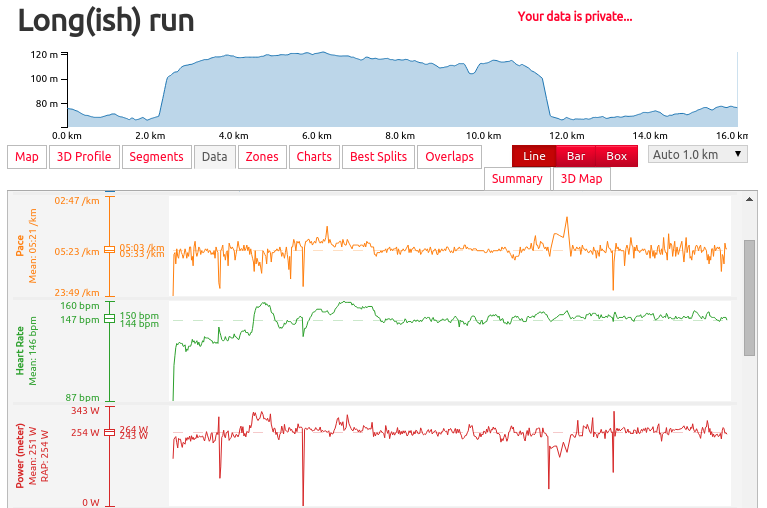
For a fairly steady run at about 5:23/km (a pace I can sustain at aerobic effort for a long duration run) power was a fairly steady 252 watts. This seems about right and corresponds reasonably well to the same normalised power output of similar effort on the bike.

I also did a short test to see how power relates to running form. Over a six minute period on a flat gravel path I did three minutes trying to hold my best running form (high cadence, mid-foot strike, short stride length, pelvis up and forward, head high) and then three minutes trying to do the opposite (over-striding, heel strike, bum sticking out, slouched shoulders). The graphs covering this period are shown below:

You can clearly see for the first part that the power is fairly consistent in a band of about 252-270 watts, averaging out at 262 watts on a pace of 4:38/km. Heart rate gradually climbs as I'm going faster than I was previously and then levels out.

The second part shows a very different picture. Power is jumping around all over the place in a band ranging from 237-318 watts, with an average of 269 watts. Average pace is a bit slower at 4:46/km (couldn't run any quicker with such a broken running style!). Heart rate continues to climb above it's previous level.

So, evidence is that power looks to be a good measure of running form and efficiency. For a given pace on a consistent terrain it looks as if a drop in running form is directly related to an increase in power and visa-versa. This is definitely something I will be experimenting with further to determine if, for a given target pace, I can achieve it with a lower power value.

Also it's probably a good way to measure the rate at which running form decays over a long run by maintaining a consistent pace and seeing how power required to hold this pace goes up over time. Another option would be to pick a consistent power and see how pace required to hold that power slows over time.

The other thing I really want to play around with is whether the running surface has a significant impact on power and whether different technique adaptations for the surface can impact that power. The only firm conclusion I have from my runs so far are that grass requires about 10-15 watts more power to run at the same pace compared to road or gravel path. Any other comparison from my runs don't have value as the only time I spent on road was at the end of the long run when fatigue had already started to kick in.

Device Weaknesses

While I'm pretty pleased with the Stryd, it is pretty much a running only device. This makes is less useful during the triathlon season as far as I can see.

First off, it's not really waterproof enough to wear while swimming (the instructions say that you can rinse it under a tap to clean, but that's about it). Also, my Suunto HRM has on-board memory to capture heart rate while swimming that it then syncs to my Ambit3 when out of the water and a connection is re-established. The Stryd doesn't have this feature.

Secondly, the Stryd pairs to the Ambit3 as a 'Power POD', which means that wearing it on the bike could give some strange results (not actually tested this yet). For example, riding a bike without a power meter but with Power POD support enabled would likely cause the Ambit3 to think the Stryd was actually a bike power meter and record some very low power values. Not sure what would happen if I had both a bike power meter and the Stryd available at the same time - which one would be selected?

So, in a triathlon scenario I'd probably be left with two options:

  • swap straps in T2 from my Suunto HRM to the Stryd ready for the run – doesn't make for an efficient T2 and probably not practical for anything but long course events
  • wear both my Suunto HRM and the Stryd strap for the swim and bike and then just clip the Stryd to the strap in T2 – slightly faster, but means wearing 2 straps for the whole event, which isn't very comfortable

I personally can't see the current Stryd iteration getting much use during triathlon except on pure run workouts.

Ecosystem Issues

While the Stryd is a pretty neat, clever and polished device, it's something very new to have power data in running mode and to have a single device that captures both power and heart rate data. At the moment this seems to have broken quite a lot of the ecosystem that I use. Hopefully this will gradually resolve itself over the next few months as everyone catches up with Stryd's innovation.

As of today, here's some of the ecosystem issues I've discovered:

Suunto Abmit3

The Ambit3 probably has the best support for the Stryd as it already allows capturing power data in running modes (on Garmin devices you have to currently run using a cycling mode to support the Stryd!).

That said, there are a couple of issues that the Ambit3 still has:

  • It currently can't stream both power and heart rate data from the Stryd at the same time. If you pair the Stryd as a Power POD then it's useless as an HRM. Suunto are apparently working on new watch firmware to overcome this problem. In the meantime I'm running with two chest straps so that I can get power and heart rate data - and it's a bit uncomfortable!
  • For some reason I'm not getting any cadence data when using the Stryd. It looks like pairing it as a Power POD disables the cadence sensor built in to the Ambit3 and assumes cadence will come from the Stryd, but this data doesn't seem to be available. Hopefully this is just a bug that will be resolved by the next firmware updates as I tend to do quite a lot of work on maintaining a high cadence.

Suunto Movescount

Movescount seems to handle runs with power quite happily. The data is captured nicely and you can graph and explore the power values.

I have however found an error in Movescount where the FIT file format export seems to be missing occasional data points. When you drop this into Stryd Power Centre it results in a very jagged graph. Training Peaks uses the same FIT files and it also has the same missing data points problem. The data points aren't missing in GPX and TCX files so I've raised this as a bug with Suunto.

Stryd Power Centre

The Stryd Power Centre site seems to work pretty well and draws some nice graphs. Will be interesting to see how this develops over time. It should grow to be fully featured as it's an integral part of the Stryd offering.

Unfortunately it deals with the error in the Suunto FIT files by rendering zero values for power and heart rate if a data point is missing, which results in a very difficult to analyse, jagged graph. Training Peaks takes a better approach by just not rendering a data point in the graph for any data points that are missing.

Strava

Strava seems to quite happily receive runs from Movescount that contain power and hold on to that data. However it currently doesn't provide any way to view the power information for a run. It does export the power data to sites that pull data from Strava (e.g. VeloVeiwer) which is good.

Training Peaks

Training Peaks takes its data from Movescount in FIT file format so exhibits the missing data points problem. It currently doesn't display any power summary information for run activities, but if you expand the activity view you can see power on the graph and get lots of other interesting power metrics.

VeloViewer

VeloViewer pulls activity data from Strava and allows you to do lots of extra analysis on your performance. It successfully retrieves all of the power data for a run and graphs it properly. Also, because it's GPX based it doesn't suffer from the missing data point problem. This will probably become my default site for analysing my Stryd recorded runs until the other sites resolve their various bugs and lack of features.

Summary

From my initial runs, the Stryd looks very promising. Running power certainly appears to be a useful metric for evaluating form and efficiency. For any given pace and terrain it looks to be a much more stable metric than heart rate and a good measure of effort expended. Still lots of experiments to do though before I consider switching power to be my primary run training metric. I will be very interested to see the output from my next track intervals session on Monday.

At the moment, I'd say that the ecosystem is the main thing that is letting the Stryd down. If you are happy to be an early adopter and work round things that don't quite function as you would want then Stryd is certainly worth some experimentation. If you are after something that is polished and just works with all your devices and running data sites then I'd suggest waiting a few more months until the ecosystem catches up with this new and innovative approach to running metrics.

Friday, 17 April 2015

Journey to My First Marathon – Part 4

On 12th April 2015 I took part in Brighton Marathon, my first ever marathon event. In this series of four posts I will be talking about my marathon build-up, training, performance and what I learnt along the way.

In the previous post I looked my race preparation and my pre-race strategy.

In this final post I'm going to cover my actual race performance and all the things I've learnt from my journey.

The Race

So, I'd finally made it to race day. I was fully fuelled and hydrated. Legs feeling strong and full of energy. Arrived at the start in Preston Park, Brighton in plenty of time.

Weather

The weather was clear skies and sunshine and probably a fair bit warmer than predicted. However, there was also a fairly stiff sea breeze that made it seem a lot cooler than it actually was. At this point in time I never even considered what impact the weather conditions would have on the race, probably due to a mix of excitement and lack of experience at this length of event.

I learnt afterwards from a friend on Strava that the elite runners considered the weather conditions significant enough to adjust their race plans slightly. Probably shows why they are the elites!

The start

At Brighton the elite group have their own start further along the main road. The remaining runners start in Preston Park and do a lap of the park before merging into the race with the elites. This had the advantage that I was able to work my way pretty much to the front of the start coral, crossing the line just a few seconds after the gun.

The downside of the Preston Park start is that the first mile consists of a tight loop of the park starting with a steepish uphill section followed by a matching downhill. This isn't really the best way to start a marathon as it makes initial pacing really difficult to judge. If I do Brighton again I will definitely be aiming to join the elite start group!

The first third

After the first mile was complete I quickly settled down and got into my flow. Pace at this point settled at around 4:18/km (6:55/mile). This was fractionally faster than my planned pace but it felt comfortable and I didn't feel that I was over-exerting myself so I decided to stay with the flow rather than make lots of little adjustments to pace.

By the time I reached the 14km mark my average pace had quickened fractionally to 4:16/km (6:51/mile) with my average heart rate creeping up to about 167bpm. Maybe I slightly over exerted myself on the first section of the run compared to plan and this probably didn't help with the problems I suffered in the final parts of the race.

However, at this point I was still thoroughly enjoying myself and feeling really strong. I therefore decided to pick up the pace a fraction and try to get my average pace to 4:15/km.

The middle third

Picking up the pace initially felt fine and I covered the next 10km right on my target pace. Then at about 25km (16 miles) things started to get harder. My pace started to slow and become more erratic, averaging out at about 4:23/km and heart rate reached an average of 171bpm.

At 28km I pretty much accepted that the goal of a sub-3 hour marathon was beyond me. I decided to settle for maintaining my new pace as best as possible, which would still result in a very acceptable time.

The final third

The last part of the Brighton Marathon course is particularly mentally tough. After going through the centre of Hove you head out into an industrial area, with a loop around the power station. There's much less crowd support in this area and very little scenery to keep your spirits up. It's just a case of focusing on your running, gritting your teeth, counting down the kilometres and thinking about the finish.

By this time I was really beginning to suffer and my pace got slower and slower, averaging off at about 4:30/km (7:15/mile). I did however have the mental presence to realise that my earlier good pace meant that all I need to do was keep going and I would still be well within my target time range.

The last 3 kilometres

Those final 3 kilometres were a mix of pain, daze, excitement, hell, enjoyment, perseverance and pleasure. By this time my left glute was rebelling and delegating a huge amount of extra effort to the hamstring. This muscle was in turn getting tighter and tighter with every step. As I went past runner after runner stopped at the side of the road with cramp I knew I just had to keep on moving.

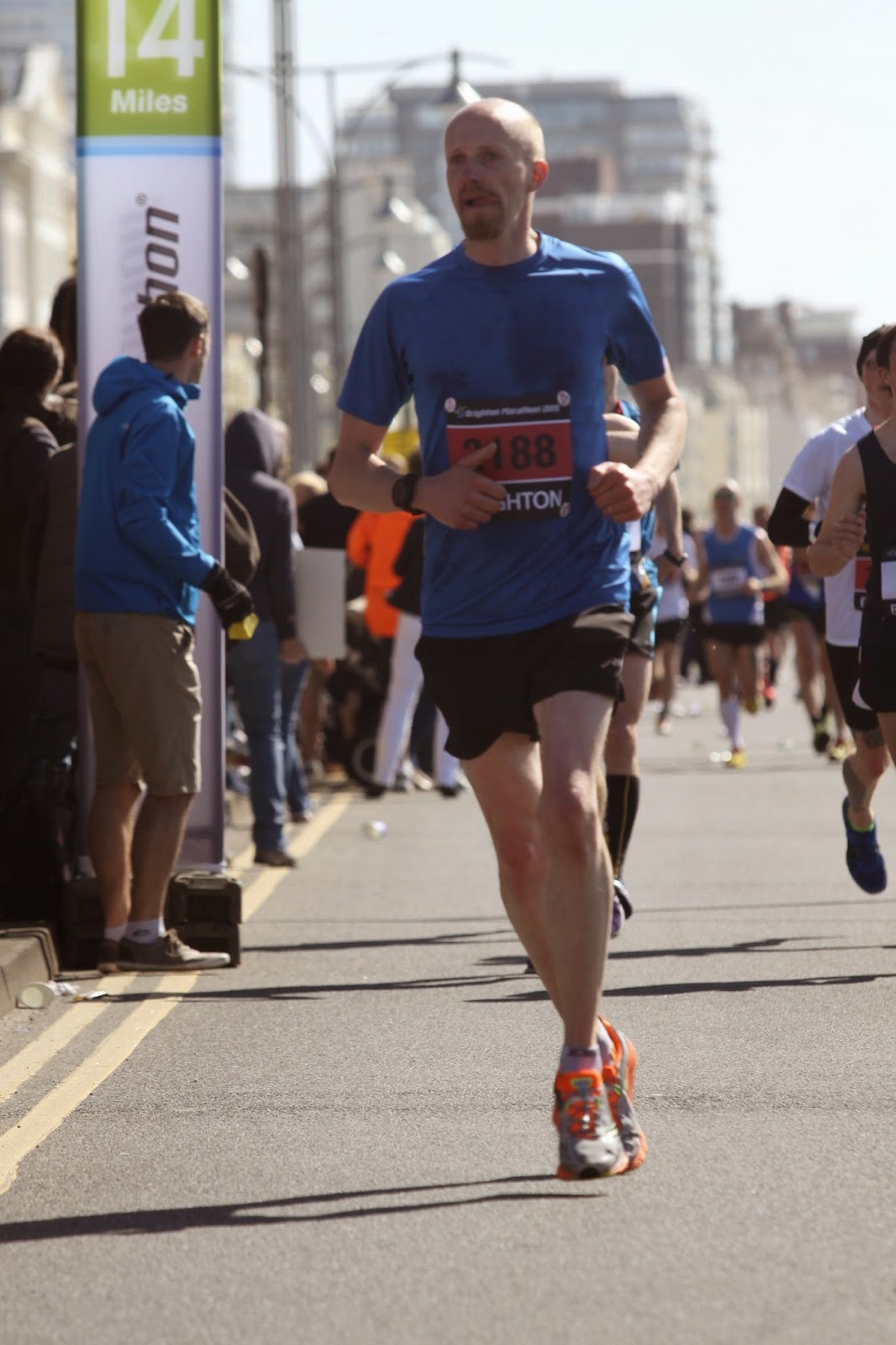
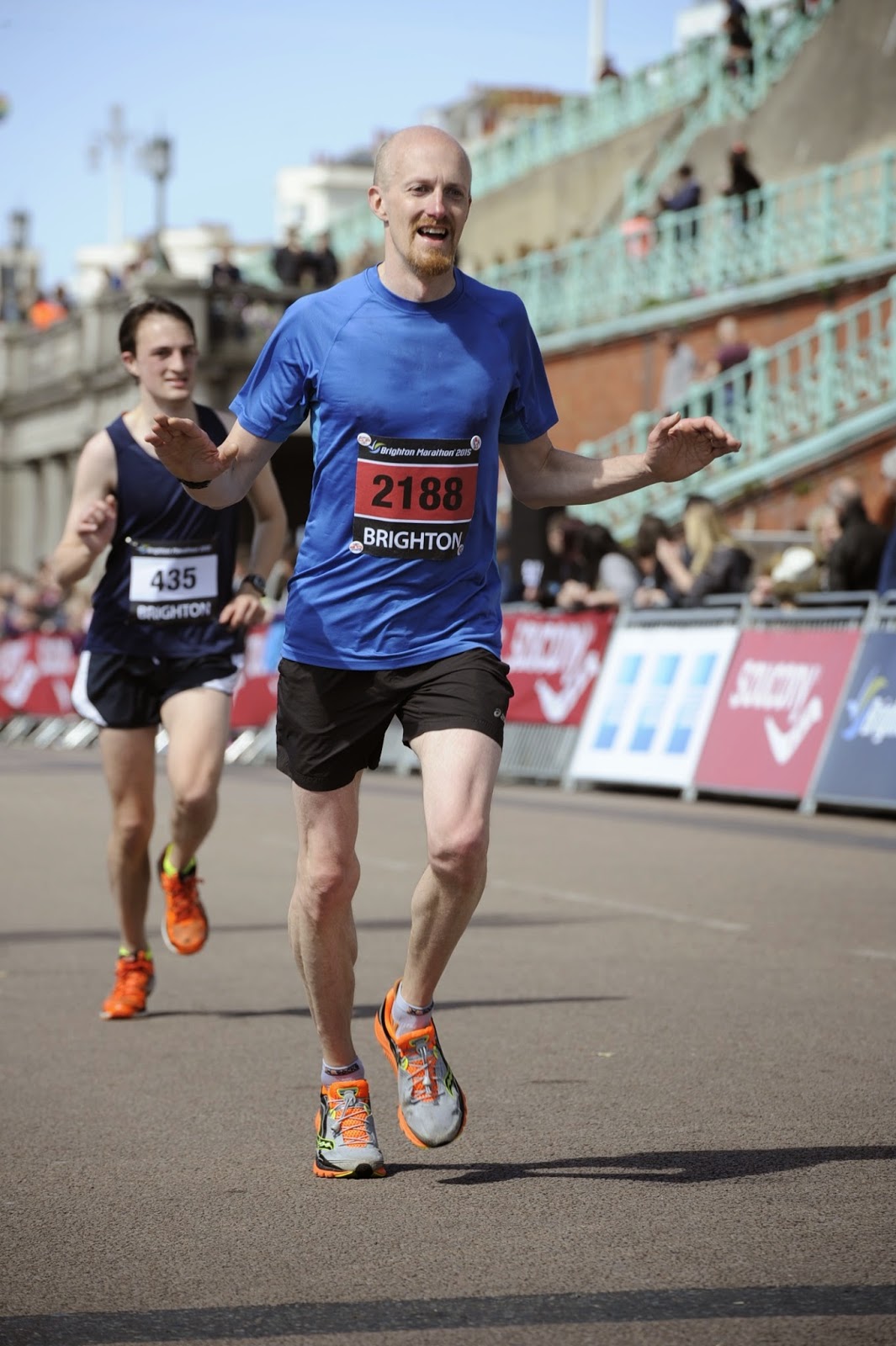
Fortunately by this time I'd made it back into Brighton and the cheering crowds along the seafront and promenade were a massive boost. If you look at some of the race photos, you can see me alternating between pained grimaces one minute and happy smiles the next.

Current pace had dropped to an average of 4:46/km (7:40/mile) for each of these last 3km. However, my watch was displaying an average race pace of 4:23/km (7:04/mile) so I knew I was on for a good time and I therefore didn't try to push any harder and risk a blown hamstring.

The finish

As the finish came into sight I tried to muster up everything I had for a final sprint, and I managed somewhere to pull out a 4:23/km pace for the final finish straight. I crossed the line with a huge smile on my face and a finishing time of 3 hours, 5 minutes and 19 seconds!

Yes, 3:05:19 for my first marathon. I was elated and not at all disappointed at missing that 3 hour mark. In fact by the time I'd reached back pick-up I was already planning my next marathon and how I would knock off those extra 5 and a bit minutes. It was also great to fire up the Brighton Marathon App and see that I finished in an amazing 160th position (165th on chip time), far higher up the standings than I ever thought was possible.

Recovery

I met up with my family and, as suggested by my sports masseur, I went and stood in the sea for 10 minutes to give my legs an early ice bath. It was then straight into compression tights and off for a nice meal to celebrate. Sunday evening and Monday morning were a bit painful as my legs started to stiffen up, but another ice bath and keeping active really helped. By Tuesday morning everything was feeling good again and with a couple of sessions on the foam roller I was out doing a 5k recovery run on the Thursday morning.

Race Assessment

So, I've finished my first marathon in a really good time, but I struggled at the end. My recent half marathon PBs suggest I could have gone faster, so what let me down?

Pacing

I did go out at a slightly faster pace in the first third than originally planned, but only by about 3 seconds per km. I also felt that I was running the first third at a relatively comfortable effort. By half way I was slightly up on where I had expected to be but spot on for a 3-hour time. All I needed to do was maintain a steady 4:15/km pace for the second half of the race. This should have been achievable based on my training and recent half marathon experiences.

I'm not sure whether I underestimated how tough the second half would be or whether the weather and hydration difficulties described below caused my pace to drop off, but I still think I'm capable of running the 4:15/km average pace for the entire distance.

Nutrition

I think I got my nutrition pretty much spot on. At no point did I feel depleted of energy and I certainly didn't hit the legendary 'wall'. After the race was complete I didn't experience any post-race energy dip or excessive tiredness so I think I must have got both my pre-race and in-race fuelling correct.

Hydration

It was hydration that I think really killed the final stages of the marathon for me. I found drinking from the paper cups far harder than I expected. I found that at most drink stations I spilt about half the water while trying to collect the cup and squeeze the top together into a funnel. This meant that I was probably only getting a couple of mouthfuls of water per drink station.

Given the weather conditions (see below) I think I was therefore loosing far more liquid than I was taking on board, even though I took a drink from every station. This certainly accounts for the gradual loss of performance in the later stages plus the early signs of muscle cramps in the last few km. I certainly wasn't unique in this situation as I saw so many people suffering during the last 10km, many having pulled up with cramp.

With hindsight I probably should have made the effort to slow down at the drink stations so as to not spill so much and therefore be able to get more water on board. Someone also mentioned in their post-race analysis that they got their wife to pass them drink bottles at a couple of points in the race. I'd never thought of that, but it's certainly an option that I will consider having available in the future.

Weather

Coupled with the difficulty I had taking on water, I think the weather conditions on the day contributed significantly to dehydration problems. It was a clear, sunny and warm day. However, the stiff sea breeze made it feel much cooler than it actually was. I think this resulted in a number of things happening:

  1. Extra effort was needed to run into the wind at a few points along the course. This resulted in more exertion that I didn't take account of in my pacing.
  2. The higher than expected temperatures and warm sun was causing more perspiration than expected (certainly much more than I'd been used to in any of my early morning training runs), but I didn't feel that I was getting hot at any point due to the cool breeze.
  3. The strong breeze was drying perspiration very quickly so it wasn't obvious just how much fluid I was loosing from sweating.

In all my previous races all I’ve needed to worry about was pacing in a head or tail wind or looking out for sunburn. This was the first race where weather had a significant impact on my performance and, given the length of the race, I needed to take it into account, but I didn’t do so successfully.

Learnings For Next Time

So, I’ve completed my first marathon in a really good time. I’ve got my good-for-age time for London in 2016 (unless they change the rules/requirements). What did I learn that I will do different next year?

Training plan adjustments

I was really happy with the P&D training plan that I followed. It seemed to work very well for me and the pacing discipline and strong scientific grounding really allowed me to have confidence in the plan.

The one change that I would make when using it again would be to add some additional marathon pace work and adjust when this occurs in the run.

First off I’d make sure that all of my long runs finish with a couple of kilometres at marathon pace. I feel that this would better prepare my legs for dealing with that last few km of the marathon when they are tired and when maintaining pace is essential for a fast time.

Additionally, in the plan there were a few marathon paced long runs, but I executed them as a short warm-up, marathon pace section and then the remainder of the long run at slow pace. When following the plan in future I will do all of the slow pace work first and then position the marathon pace work at the end. Again, the goal will be not to teach the legs to run a marathon pace (they can already do that) but to teach them to do it when they are tired.

Hydration strategy and practice

If the next race I do is planning to use paper cups for water I’ll be setting up a drinks station in my road and practicing and practicing until I can pick up cups and drink a decent amount from them without spillage! I really should have done that before Brighton but I just didn’t consider it such an issue.

I’m also certainly going to be going away and researching hydration strategies, fluid loss to perspiration and so forth. There are systems you can use whereby you weigh yourself before and after runs at different efforts and in different temperatures. From these it is possible to determine your expected rate of fluid loss and then use this as to plan and influence how much and how often you need to drink during a race. I plan to never go into a race again without having full certainty on how much fluid I need to consume.

Finally, if I have supporters coming along to cheer me on at my next marathon I will be making sure they are each armed with a disposable bottle of water with an added electrolyte tablet. That way if I’m struggling to take on enough water at drink stations I can always be sure that there will be a good alternative option available.

Strategy improvements

I still think my pacing strategy was reasonably sound and I think I followed it fairly successfully. However, for my next marathon I will aim to be much more precise with pacing in the early part of the race and not let myself get too carried away (even if it’s only by a few seconds per kilometre).

I’ve also learnt that as the distance of the race increases I need to take much more note of the weather conditions and adjust my expectations and pacing plan accordingly. In particular, I need to make sure I’m not over exerting into a headwind and getting the most from a tailwind rather than trying to maintain a consistent pace throughout.

The Next Marathon

Now that my first marathon is complete I’m already planning the next. Provided the rules don’t change I’ll be planning to exercise my good-for-age entry into the Virgin London Marathon in 2016. And I’ll be working really hard to get that sub 3-hour time on my next attempt.

Monday, 8 September 2014

Team Kennet Newbury Triathlon

7th September 2014

This weekend I completed in my first every triathlon. It went great and I'm totally hooked. Looking to do more next year and gradually work up to the longer distances (once my swimming has improved).

Overview

Newbury Triathlon is a super-sprint event based at Northcroft Leisure Centre in Newbury, West Berkshire, UK. It consists of a 300 yard pool swim, 22km bike ride and 5km run. It is organsied by Team Kennet, the local athletics and triathlon club, and has an entry limit of 450 competitors.

Result

Overall position 39th out of 440. In the V40 male age group 13th out of 175.

Swim6:16
T10:43
Cycle42:23
T20:40
Run19:44
Total1:09:47

Organisation and Atmosphere

The event was incredibly well organised and ran extremely smoothly from a competitor's point of view. Everything ran nicely to schedule. Registration was very smooth with no queueing.

The transition area was very relaxed but still managed to remain very organised. The staggered nature of the swim starts means that there's a small continual flow of people through transition rather than large groups of people, which keeps things pleasant. Being allow to access transition at any point when you are not racing was also very helpful.

The marshals did a great job and were very friendly and clear with their instructions. Marshals were stationed at all the correct places for bike and run so it was pretty much impossible to go wrong and the signage was good and clear. Particular thanks to the bike marshals on the roundabouts and junctions who did a great job of keeping riders safe and the race flowing.

Possibly the only slight criticism I could raise is the delay in publishing the results. However, I understand they had to change timing suppliers at short notice, so this can be forgiven.

The overall atmosphere for the day was great. The triathlon had a nice mix of serious triathletes, athletes attempting their first triathlon (me for example) and plenty of people participating for a personal challenge or to raise money for charity. The arrangement of the course meant good support at the pool side, at the end of the bike leg and at the run finish – just what was required to keep you pushing hard.

The Swim

The swim leg takes place in Newbury's lovely outdoor heated lido pool, which originally dates from 1870 (redeveloped in 1937). The pool is a very unusual 75 yards long and a maximum depth of 2.8m. It's a high sided pool, so can be quite choppy when full of people.

The swim is four lengths of the pool, with two competitors being started every 30 seconds. This means that it takes nearly two hours to get through the entire field, but that does have the advantage of spreading out the transition, bike and run stages.

There were plenty of competitors swimming breast-stroke and even a couple doing the whole thing backstroke. This meant some overtaking was required, but fortunately the pool and lanes were wide enough that this wasn't a problem.

My swim went pretty well and I was able to complete the four lengths in 6:16, which was slightly better than expected.

T1

Jumping out the pool, a short run out into the car park for transition. Found my bike easily and things went pretty smoothly. I did find that I underestimated just how wobbly I'd be after the swim. I'd elected to wear socks, as I know running without gives me blisters, and trying to balance on one foot to put them on was somewhat tricky!

A quick run out of transition and then on to the bike and away. My numerous practices at mounting the bike with shoes pre-attached and held in place with rubber bands proved well worth the effort.

A T1 time of 0:43 was most acceptable for my first time ever doing this under race conditions.

Bike

The bike leg starts with a short up-hill section, so important to get into the shoes and get them tight as soon as possible. Then it was up to a bigger gear and off. The roads were pretty quiet and I managed to complete the whole bike without needing to give way to any traffic, helped by excellent marshals making sure riders knew the junctions were clear.

The first half of the 22km bike ride is net up-hill, through Boxford, Welford and Wickham, with a steep climb just after half way. Managed to get down on the drops for a large part of this and overtook a few riders. Only one rider (in full streamline kit) came past me.

The second part is a lovely straight and mostly downhill section all the way home. Down on the drops again and cruising along was very pleasant. Felt a slight cramp twinge in my left calf but luckily it didn't come to anything. Picked up a few more riders along the way, polished off a 33shake chia energy gel and entered the final section feeling really strong.

Dropped down to a low gear to get the legs spinning fast ready for the run. I'd also been doing loads of practice at slipping out of shoes while still on the pedals for a quick bike dismount. That worked pretty well, but still room for improvement, and I was off the bike with my family cheering loudly behind me.

Total bike leg time of 42:23, which was significantly better than I had hoped for.

T2

Second transition went as well as I hoped. Jelly legs off the bike is still quite new to me (despite a number of brick training sessions) but it didn't slow me down too much. Run shoes on quickly (elastic laces are a superb invention) and off.

A T2 time of 0:40, which again I was reasonably pleased with considering it was my first ever attempt under race conditions.

Run

The run part is a nice course, mostly on footpath or the canal tow-path. A couple of small slopes, but mostly flat all the way. Initially the run was feeling really tough, but after the bike legs wore off I managed to get into my running flow. Gradually started to pick off other runners, although overtaking was sometimes difficult due to the narrow paths.

At the end of the tow-path you have to cross a canal bridge, which is a bit tough on tired legs. Then it's into the field, which you have to run round once to the finish. Loads of support and cheering family around the field was a welcome boost and despite having to run on grass I was able to pick up speed for the last couple of hundred meters.

A run time of 19:44 for a total time of 1:09:47. A very pleasing result and bit ahead of what I expected my best achievable time might be.

Conclusion

A great event, very well organised and very enjoyable. I'm now hooked on triathlon and will be doing some more events next year. Hope to step up to a full-length sprint with open water next time providing I can continue developing my swimming over the winter.

Another bonus is that the kids (nearly 8 and just turned 9) are now really excited about triathlon as well, so chances are they will want to enter some junior triathlon events next year as well.

Wednesday, 7 May 2014

10 Day Training Cycle Update

In this post I talked about my experiment to switch from a 7-day weekly cycle to a 10-day version. This is the follow-up post describing the results.

Background

So, I've now been on a 10-day cycle training plan for just over two months. I started with an initial plan of four cycles, covering a period of just under six weeks. I'm now about half way through a second four cycle block leading to a 10K running race at the end of May.

In September I'm competing in my first triathlong, so my plan as been about laying down the groundwork in swimming and cycling while building up to peak 10K running fitness.

In my previous post I described how I went about building the plan. In the remainder of this post I want to talk about how the plan actually worked out for me and changes that might be needed.

Sticking to the Plan

I actually found keeping to the plan was very easy in the most part. This was probably because I built the sessions around the periods that I knew I would have time to train. That made building the plan more challenging, but following it much easier. Had I built the perfect plan then tried to arrange my life around the training then I suspect it would have been much more challenging.

However, towards the end of the first block of cycles I picked up a small running niggle and at around the same time my work situation changed. This threw the plan into some chaos and required I make some fairly significant changes to the sessions.

Flexibility of the Plan

Given the challenges I faced building a 10-day plan in the first place, I expected that making session adjustments would be difficult. However, I was pleasently surprised how easy it was to change. Some running sessions had to switch to slow recovery runs and I had to dump some runs and put a bit more swimming in to replace them.

Adding swimming was the most challenging part of building the plan as there is a double constraint involved: the need to match both the time I can train and the times my local pool has lane sessions. However, the fact that a 10-day cycle is much more spread out than a 7-day one means moving slots around is much more achievable. I think this was a big win for the 10-day cycle approach and not something that I was expecting.

Frequency of Sessions

When I built the plan my goal was to include one swim session, one long bike session and one running interval session in each 10-day block. The rest would be filled with slower runs and strength sessions. Some blocks had an extra bike session if space was available.

What I discovered when executing the plan, however, was that only one swim session and one interval run session every 10+ days wasn't enough. The longer gap between the sessions was hampering my ability to improve consistently. I found that to get the improvement that I was expecting I had to swim at least once each week and interval sessions needed no more than 7 days gap between them.

In practice this means having 2 swims and 2 interval sessions in each 10-day cycle block, which then tends to crowd out other sessions. Or, having interdependencies between cycles, which makes planning way more difficult. I haven't managed to solve this challenge yet and if I stick with a 10-day cycle I will be trying to address this in my next planning block.

Fitting into My Work/Life Schedule

The other challenge that I found with a 10-day cycle is that my life is inherently structured around a weekly schedule: the swimming pool lane sessions that are compatible with my work schedule only happen on two days each week; various activities with the children happen at the same time each week; work follows a stict Monday to Friday schedule and so on.

What I therefore found as I adapted the first plan and started building the second plan is that certain sessions ending up having to be placed in exactly the same slot each week and then the remaining sessions positioned around them. The result is that I would often end up with two quite intense sessions very close together or two important sessions (like the long run) a wide distance apart. I found this very challenging for building consistency in my training.

Conclusion

I found the 10-day cycle training plan to work quite well and I was surprised that it was much more flexible than I was expecting. The less crowded plan was certainly welcome on busy weeks. However, the problem with getting the correct frequency of certain key sessions and fitting the plan around a life that is structured weekly are particular challenges for this approach.

For my next block of training I will be planning both 7-day and 10-day cycles and I will see which works out best with my new job. Given the need to swim more frequently, I think the 7-day approach may win purely down to the very restricted lane swimming times at my local pool.

Sunday, 2 March 2014

Pacing the Half Marathon

This weekend I took part in Reading Half Marathon. I crossed the line in 1:30:01, a personal best by over 7 minutes. My 12 week, 390 mile training plan prepared me fantastically well. The only downside to the day was missing the sub-1:30 time by a tantalising 2 seconds. This was purely down to a very simple mis-calculation in my pace timing.

The Goal

Prior to the race my goal was a sub-1:32 finish time for the 13.1 miles, with a stretch goal of sub-1:30. I knew I would be comfortable for the 1:32 finish as I'd done plenty of training at the 7:00 per mile pace needed to achieve this. I was however unsure about my ability to sustain a 6:50 pace for the full distance, despite having achieved this pace for a couple of miles at a time in training.

I therefore decided a pacing plan starting at the 1:32 pace to get into my stride and then gradually speeding up to reach the sub-1:30 stretch goal. That way if it was getting too tough then I would be able to back off back to the 1:32 pace and still meet my main goal.

By starting slower as well it makes it less stressful dealing with the first couple of miles of crowded roads and the overtaking of all those people who, for some reason, seem to insist on setting out at the front of the race at a pace they can't sustain for even the first mile! (rant over).

So, my plan was as follows: 07:00 per mile for the first 4 miles, 06:50 per mile for miles 5 to 8, and finally 06:45 per mile for the last 5.1. Following this plan would get me home at 1:29:42, giving an 18 second margin for any small mistakes or misjudgements.

The Reality

So, the first 4 miles went well with 7:03, 6:58, 7:02 and a 6:46 (slightly fast on the last one, but then it was downhill). At this point I was still feeling strong, so decided to up to the faster pace. Miles 5 to 8 were solid at 6:42, 6:29, 6:54 and 6:55 (downhill for two and then uphill for two). At this point I was ahead of my scheduled 8 mile split time by about 24 seconds and still feeling good.

Now was the time to make a decision, so I picked up the pace again and ran the next 5 miles at 6:49, 6:42, 6:41, 6:51 and 6:49. Not so pleased with miles 12 and 13, but they were into a headwind and I still thought I was up by enough that loosing 10 seconds didn’t matter.

Then came the problem, running time to this point was 1:28:43 and supposedly only 0.1 miles left. However, not being able to run the optimal racing line at all times and having to weave a bit to overtake meant I was still 0.2 miles from the line! Realising this I dug as deep as possible and tried to pick up the pace. Managed a 6:15 per mile pace sprint, but by that time it was too late to pull back those vital few seconds.

The Lesson

So, I missed my sub-1:30 stretch goal by just 2 seconds and all down to planning for 13.1 miles rather than the 13.21 that I actually ran. Had I thought about that initially I'm sure I could have planned a single second faster on each mile throughout the race and been able to hit those splits.

Lesson for the future: unless you are right at the front of the race, plan to run slightly further than the actual race distance and plan the splits accordingly.

Friday, 28 February 2014

10-Day Training Cycles

This week on the Kinetic Revolution Podcast there was an excellent interview with Gary Reynolds of Runners Paradise. The subject was on training cycle length and how we tend to focus on a 7-day cycle (because that's how long a week is), when in fact other lengths, such as a 10-day cycle might be more appropriate.

This talk about training cycles couldn't have come at a better time. I was right in the middle of building a rather full-to-bursting weekly plan which I have now adapted into a much better spaced 10-day alternative. I thought I'd share my experience as evidence that this approach really can work.

The Plan Contents

As background: I'm just coming off a 12 week plan that I built myself in preparation for Reading Half Marathon this weekend. The plan was a 7-day one, consisting of 5 run sessions, 2 strength/flexibility sessions and 1 rest day. It has gone very well and all that remains now is seeing how well I perform on Sunday.

I've now got 12 weeks until my next race, which is my local 10K. This is really a 'B' race for me, so I thought it a good point to introduce a 6 week core aerobic, strength and flexibility cycle while still keeping my eye on a good 10k performance. In addition to this I'm doing my first ever triathlon in September (just a short sprint one) so I though this would also be a good point to start introducing some swimming and bike work as well.

In each cycle I'm therefore aiming to fit in the following sessions:

  • A long run of around 10 miles
  • An easy 10K run
  • A run speed session (tempo, hills or intervals) just to maintain form for the 10K
  • A long(ish) bike ride of around 1hr 30mins - 2 hours
  • A shorter bike ride
  • A swimming session of about an hour
  • Two strength and flexibility sessions
  • A weekly game of five-a-side football (as this helps break up my movement patterns)

A 7-Day Cycle Plan

My initial attempt was to squeeze this into my normal weekly template, but it ended up being VERY crowded, to the point where a Thursday would end up being a long bike ride in the morning and then a 5K easy run at lunchtime; Tuesday would have two big workout sessions; and Wednesday swimming would be a late 9pm-10pm session (local pool lane time), followed by a 6am start on Thursday morning to fit in the bike session before work - not ideal! This initial draft is shown below. The colour code is: Red - running, Green - bike, Blue - swim, Yellow - gym work. Five-a-side football is always on a Sunday evening.

I really wasn't happy with this plan as it felt almost like overtraining in what should actually be a more relaxed period between two heavy, race focused ones. The idea of a 10-day cycle was therefore very appealing.

I was initially somewhat sceptical as to how my sessions would fit into a 10-day plan. My training times have LOTS of restrictions on them, including:

  • I try to avoid training in the evenings where possible (other than strength and flexibility work which I do at home) due to child care, charity work and making sure my wife has time for her workouts and events.
  • Weekends are family time, so have no training booked against them until the kids are in bed at the end of the day.
  • Sunday evening is five-a-side football.
  • Monday, Tuesday and Wednesday I have a 5:15am start in order to get to work so I normally restrict myself to getting up at 4:30am on only one of these days in order to get a session in first. Any more would be too tiring.
  • Thursday and Friday I work from home so these are the only days I can really fit in any long sessions (usually by getting up early and doing them before starting work).
  • Evening adult lane sessions at my local pool are 9pm-10pm, which is a bit too late for me given my early morning starts.

A 10-Day Cycle Plan

So, what I did is allowed a couple of days recovery from Reading Half Marathon and then broke my six weeks down into four 10-day blocks (instead of six 1-week ones). I then fitted in the sessions that were immovable, such as five-a-side football on a Sunday (which I will cycle to and from) and the long sessions that have to take place on a Thursday or Friday morning. I then fitted the rest of the sessions around this starting point, particularly trying to avoid late evening swimming if possible (which I managed on all but one day).

The net result is that over the six weeks I'm getting less of each type of session in (4 of each instead of 6 of each) but it feels much more relaxed. There are virtually no doubling up days and the number of rest days is the same as the 7-day plan. The training commitment fits better with family life and, being less exhausting, means I will be able to focus more intently on session quality rather than quantity.

So, here’s the plan adjusted to a 10-day cycle. Colour scheme is still: Red - running, Green - bike, Blue - swim, Yellow - gym work and black blocks just mark out the 10-day windows.

All-in-all, it looks and feels like a much more sustainable plan, which will be less exhausting and thus (hopefully) less chance of injury. The big open question I do have is to how amenable it will be to last minute schedule changes, such as a late meeting, which might result in having to move a few sessions around. I’ll report back in six weeks as to how well it worked out.