Showing posts with label pacing. Show all posts

Tuesday, 25 July 2017

Outlaw Triathlon - Part 3 - My Race Performance

This is one of a three part set of posts about my first iron distance triathlon: Outlaw Triathlon 2017. This post contains the analysis of my race performance. You can also read about my training and my review of the event.

In this final post in my series on the Outlaw Triathlon I want to review my performance, look at what I learnt and how to improve if (when) I do another event of this distance in the future.

Context

Prior to this event I'd never done an iron distance triathlon before. In fact, apart from the middle distance event I did in the build up, the longest I'd gone before was an olympic distance tri. I'd also previously run two marathons, including a 2:59:34 at London in 2016.

I've already covered training in another post in this series and felt that I was going into the race in the best possible shape that I could be. No injuries or niggles. Calves felt a fraction tight, but I find that's quite common for me after a taper period.

The Swim

I've been working really hard on my swim in the build up. Made some huge improvements. Prior to starting the training plan the longest I had ever swum in one go was 2.4km. Target pace was 2:00/100m that I'd been practising in training.

The main thing I don't like in a mass start swim is the washing machine that occurs while everyone gets going and jostles for a good position. I hate having my legs pushed down from behind. However, over the last couple of races I've been made a real effort to start in the middle of the pack to help overcome this fear. It worked!

I positioned myself at the front of bay 3 (70-90 minute swim time), figuring that my target time of 75-80 minutes would let me swim at the same speed as those around me. As it turns out this was a great decision. I was able to get away cleanly and by the time we merged with bays 1 and 2 the fast swimmers were already away and I had got into a good rhythm.

I managed to get in with a good bunch who all seemed to be able to swim in a mostly straight line. Got my stroke nice and smooth and my breathing nice and even. Being in a group like this creates a great drafting effect, meaning it's possible to swim quite fast with far less effort. Also the nice straight Outlaw swim course meant I didn't have to spend much time sighting as I have the fortune of generally being able to swim in a straight line in open water.

The swim seemed to fly by and I came out of the water with a swim time of 1:13:52 at a pace of 1:54/100m, so significantly quicker than expected. Got my wetsuit off fine, but a slight touch of cramp in both calf muscles while doing so was a bit worrying. Fortunately it didn't turn into a full cramp and eased off as soon as I started moving into the change tent – but did leave me with calf muscles tighter that I would have liked.

T1

I swam with my tri-suit under my wetsuit, so no need to get changed in T1. Just a quick foot dry and put some socks on. Number belt, gloves, sungalsses and bike hat plus a few essentials into the rear pockets. Transition time of 5:37, which I would have liked to have been at least a minute quicker. Need more practice getting stuff in and out of kit bags!

Bike

I had a brilliant bike leg. During my long training rides I'd been averaging a speed of just over 29kph on a slightly hillier route than the Outlaw. I was therefore hoping that less hills and race day fitness would allow me to push that above 30kph and thus hit the sub-6-hour bike split. It worked!

The bike course is made up of three loops. Over the first two I was averaging around 32kph. By the third lap I was starting to tire a bit but also my calf muscles continued to tighten up. Knowing that I'm prone to tight calves at the end of a marathon I took the decision to back off just a fraction to preserve my legs for the run as much as possible. However, I was able keep the average speed high and come home with a bike time of 5:58:26, so job definitely done.

Given that prior to starting training for the Outlaw I'd only ever done one ride over 100 miles, to achieve such a good bike time was more than I had hoped for. I also feel that I got the bike nutrition pretty much spot on (but that's covered in its own section later).

T2

Nothing particularly special about T2. The marshals rack your bike for you, which is most welcome. Then it's into the change tent to switch to run gear. I decided to run in my Saucony Type A6 racing flats and go with tie up laces. I felt the few seconds spent tying laces was well worth it given the extra comfort and fit over using elastic ones. Time in T2 was 3:15, which was good considering the amount of kit bag faffing involved!

Run

The run was tough: far harder than I was expecting. Given that I did a sub-3-hour marathon in 2016 I was hoping to breeze round a 3:30 with the goal of pushing for a 3:20 if possible. Having never done this distance triathlon before I was slightly caught out at just how hard the run would be directly after such a long swim and bike.

(Note: actually a 3:46:58 as my watch died 8km from the end!)

My run problems were three-fold: not getting my run plan right; not getting my run nutrition right; and the tight calf muscles carried over from the end of the swim and the bike leg. This resulted in a 1:43:53 first half of the marathon, followed by an abysmal 2:03:05 for the second half. I've certainly learnt some good stuff for the future! I think the main problem was that I approached the run as if it was a standalone marathon (something I was already familiar with) rather than the third element of a long distance tri.

A happy face at the start of the run

I'd done all my long brick sessions with a run at target race pace of 3:37/km, with runs up to 1 hours duration. Throughout the training I always felt comfortable at this pace so set my race plan accordingly to just come off the bike and hit and hold this as a steady pace. I also planned a run nutrition strategy around what I would normally do for a marathon (see the nutrition section below).

What I discovered about 18km into the marathon was that this strategy didn't work. I then had to slow down quite a lot and take more time in the feed stations getting my fuelling correct. However, the constant stopping and starting really aggravated my tight calves, meaning that for the second half of the run my form and efficiency were way below normal. The result being that the run became even harder and my pace slowed down to about 5:30/km, which is way slower than even my typical long run pace of 5:10/km.

Feeling the pain towards the end

The final half of the run just became a case of breaking the distance down into a series of short sections from the current feed station to the next, walk through the feed station taking on fluid and fuel, and then sum up the energy to start running to again towards the next feed station. On the plus side I did still manage to pick up the pace for the last lap of the lake and run faster down the finish funnel!

One further problem on the run was that my watch ran out of battery with 8km to go. Not a major issue as by that time I wasn't using it for pacing as I was just moving the best my legs would allow. However, it would have been a disaster if I was close to target pace and relying on the power data from my Stryd footpod.

Overall, happy to have finished the run in an acceptable time of 3:46:58. I learnt a lot and will definitely be planning a different strategy if (when) I ever do another long distance triathlon.

Nutrition

As already mentioned, my nutrition was a bit of a mixed bag. I think I got it pretty much right until I hit the run, as which point my plan was totally broken.

Pre-race was my standard approach of a huge bowl of porridge and a coffee for breakfast, followed by a banana and sipping a bottle of water about 30 minutes before racing.

On the bike I planned drinking four 750ml bottles of fluid: half water and half High-5 Zero electrolyte drink. Aiming to drink every 15 mins. Food wise I went with a mix of Chia Charge flapjack bars and small bags of pretzels. These were consumed as follows:

  • 0:15:00 – Chia Charge bar
  • 1:00:00 & 1:30:00 – half Chia Charge bar
  • 2:00:00 – 30g pretzels
  • 2:30:00 & 3:00:00 - half Chia Charge bar
  • 3:30:00 – 30g pretzels
  • 4:00:00 & 4:30:00 - half Chia Charge bar
  • 5:00:00 – 30g pretzels
  • 5:30:00 – Chia Charge bar

The first Chia Charge bar was to refuel after the swim. Then eating every 30 minutes was a great way to break down the ride into smaller segments (useful advice I got from a magazine article). This plan worked out at about 55g of carbs per hour, which I think was pretty much spot on for fuelling on the bike.

The only complaint I have about my bike fuel strategy was that I struggled with the very last Chia Charge bar being way too sweet. I don't normally each a huge amount of sweet carbs so I think five flapjack bars was a bit too much.

I came off the bike feeling well fuelled and hydrated ready for the run. (The fact I made it 18km into the run before problems hit shows I probably got it right). However, my run nutrition plan turned out to be rather lacking!

For a standalone marathon, my nutrition is usually to just take on a couple of mouthfuls of water every 5km and a 33Shake chia gel every 8km. This has always worked well for me, so that's what I went for. However, I didn't take account of the fact that my normal marathon nutrition is based on having reserves of fuel and hydration in my body at the start of the marathon, so my race intake is just top-up rather than replenishment.

On the first half of the run I ran through each feed station, taking a mouthful of water as I felt like it and hitting my chia gel intake at 8km and 16km as planned. However, the chia gels only have 11g of carbs each and I probably only drank about 100ml of fluid in the first part of the run. Therefore at about 18km I hit both energy and fluid deficit, which massively curtailed my pace.

Realising what was happening I backed off and make an effort over the next few aid stations to walk through them and take on plenty of electrolyte drink, some flat coke and a goodly number of Jaffa Cakes! It took about another 10km of this strategy before I felt my energy levels starting to restore.

The remaining 14km of the run I switched to a strategy of walking each feed station making sure that I kept fluid and fuel levels topped up. No more energy dips, but by this time my tight calf muscles were the main hindrance to me being able to get back to any measure of a decent running pace.

Learnings

Having never put all three event distances together in one go before there were always going to be lots of things to learn from the experience. This post details my analysis of my race and here are my list of learnings that I will take forward for the future:

  • Pre-race massages for tight calves - I know that I generally suffer from tight calves, especially towards the end of a marathon. However at shorter distances it doesn't normally impact on my performance. For long distance events like this I need to spend more time ensuring that there's no tightness carried over from training into race day. A few visits to my sports massage guy in the weeks before race day will definitely be built into my training plan next time!
  • More savoury items on the bike - fuelling on the bike was sound but too much sweet stuff, swap at least one flapkjack for something more savoury.
  • Different race plan for the run - need to adapt the plan for the fact that it's not a standalone marathon. In particular adjust the target pace to allow for a few seconds of walking through the feed stations to ensure time to fully take on fluid and fuel.
  • Better nutrition strategy for the start of the run - plan run nutrition to continue intake of around 55g of carbs per hour plus aiming to consume 1,500ml fluid over the marathon distance. This requires fully utilising the feed stations in the early stages of the run so that fuel reserves never drop too low.
  • Different watch configuration - I had my bike watch config set to 'Good' GPS quality (rather than 'Best') but this still consumed too much battery. Reduce the GPS quality to 'Okay' for future long distance events .

Conclusions

It was a tough day with both high and low points. However, I finished my first long distance triathlon and smashed my 11:30:00 target by almost 22 minutes!

Will I do an iron distance triathlon again? Yes, probably

Next year? Definitely not!

I'm planning an easier year next year with some shorter distance triathlons, a few more running events and a bit more focus on athletics. Watch this space for a 2019 event though...

Wednesday, 9 September 2015

Newbury Triathlon 2015

This weekend saw me compete in my third ever triathlon - the Team Kennet Newbury Triathlon 2015. This was the same event that I did last year for my first triathlon. It's nice and local to me and has lots of people that I know competing.

This year as well as the event itself I had a little smack-down going with some local friends (Nick and Andy) as we are all at roughly the same performance level but have never raced against each other before. An added motivation to do well!

The race is a sprint triathlon format, based at Newbury's Northcroft Leisure Centre. It consists of a 300-yard pool swim, 22km bike ride and a 5km run. Last year I finished in 40th place (out of about 400 starters) in a time of 1:09:48. This year I'd trained harder and had more race experience, so I was hoping for a much better performance.

Preparation

When I did Newbury Tri last year I'd only been swimming for about eight months and cycling for about five. Since then I've been swimming every week and two or three times a week for the last 4 months. I've also put in a lot more cycling mileage, including a lot of triathlon specific bike training. I've also upgraded my bike, adding aero bars and adopting a much more aggressive riding position. I was therefore much more prepared both physically and technique wise to tackle this event.

In addition, I've also completed in another big triathlon event (Blenheim Palace Tri) and done a lot more transition practice, so I was a lot more confident mentally as well as physically. This was also a close friend's first triathlon event so I'd spent a fair bit of time helping him to prepare, practice transitions and so on. It's amazing how much extra clarity and confidence you get after having taken someone else through the whole event and procedures!

Pre-Race

The morning dawned clear and sunny with almost no wind, but pretty cold. Once the sun got going it started to warm up nicely. Perfect racing conditions. Met up with my friend and we took a nice leisurely cycle for the four miles from our homes to Northcroft Leisure Centre. This made a nice little leg spin to get the muscles moving.

Arriving at the venue we headed into registration. Numbers collected; race timing chip round the ankle; hands graffiti'ed with maker-pen numbers; technical t-shirt grabbed. As with last year the registration process was well organised and effortless. We took our bikes into transition and I helped my friend set up as his start time was 90 minutes before mine. Also met up with Nick and Andy to discuss the prospects for the day and drool over Nick's slippery bike!

Next it was off to pool-side to meet up with both mine and my friend's families and cheer him on through the first stage of the race. Interestingly, I was far more nervous for him that I was about my own looming race. He had a great swim and was soon on his way on the bike.

Now it was time to focus on my race. I returned to transition and set up all my kit. Bike shoes attached to cleats and held level with elastic bands. Running shoes with a bit of talc and some vaseline, so that I could bike and run without needing socks – something I've been practising over the summer and a great speed up in T1. Number belt, bike helmet and sunglasses. Nice and simple.

The Swim

Newbury Triathlon takes place in Newbury's amazing 75 yard (72m) long outdoor heated Lido pool. The original Lido dates back to 1870 with its current form being from the 1930s. It's a lovely place to swim and I've been using it each week for training since it opened at the beginning of summer. Sadly the poor August weather this year meant it didn't get used as much as it should have. Hopefully this won't effect any decisions about opening it next year!

The swim is four lengths of the pool, for a total distance of 300 yards. Competitors are set off in pairs at 30 second intervals. You swim up one lane, move across a bit swim down the next, under the centre rope and up the third lane, and finally across a bit more to the final lane for the last length. Up the steps in the corner and out through a little gate into the car park transition area.

Swimming is by far my weakest discipline, despite all the effort I've put in to improving it. However, the first two lengths I started strong, maintaining a good bilateral breathing pattern. By the end of the second length I was overtaking one of the swimmers who started 30 seconds before me. Lengths three and four I had to switch to breathing every two strokes in order to keep my pace high. Overtook the other person from the pair ahead of me. Out of the water and through the gate in 5:47 – 30 seconds quicker than last year.

Excluding the pool exit part, pace for the swim was about 1:44/100m, which is well above the pace I usually sustain, so very pleased even if there is still a long way to go in my swimming journey.

T1

The first transition from swim to bike is usually the most tricky. Balance is effected from just having moved from a horizontal to vertical position. There's also a few bits to do: sunglasses, helmet and number belt. This year I opted to cycle and run without socks, so that was a lot less faffing than my previous triathlons. My official T1 time was 35 seconds, which was the second fastest of the day and 9 seconds faster than last year. Except...

After crossing the mount line it all went a bit pear shaped: I crossed the line and climbed on the bike and as I did this I managed to steer the bike off the path onto the grass. Failed to slip my right foot into the shoe and while sorting this out my left foot fell off the pedal. The left shoe then dragged the floor and separated from the cleat. Got the right foot in and the bike back on the path but left my other shoe behind on the floor! Had to stop the bike, get off and go retrieve the shoe before finally sorting everything out and getting going again.

Amazingly, the GPS trace shows this only costing me 20 seconds, but that was still two places lost in the final standings. I really need to spend a lot more time practising the bike mount before my next event in October!

The Bike

After a disastrous start, I was determined to push hard on the bike. I knew Andy was starting only a minute and a half behind me, was a similar speed swimmer and a much faster rider so I wanted to stay ahead of him for as long as possible.

Got down on to my aero bars as quickly as possible and was soon overtaking other riders. Powered through the course as hard as possible, overtaking all the way. Heart-rate averaging about 170bpm all the way, which for me is pretty much on my lactate threshold effort. Looking as some estimated power readings (I don't have a power meter), they show a mean estimated power of 199w, normalised at 248w. This is the highest estimated power I've achieved over a sustained effort, so very pleased with this.

The first part of the course is a gently undulating country road. Nice and easy to ride, but requiring care when overtaking other riders as oncoming cars are often not quite as far over their side of the road as they should be. Next comes the gentle climb from Welford to Wickham. It's not very steep, but goes on for quite a long time, with the route's steepest hill at the end. I was buoyed going up this hill as the rider I was overtaking shouted out “you're going pretty fast!”. Thanks, it gave me a boost. The final section back to Newbury is a busier road, but it's pretty much flat or slightly downhill the whole way. Perfect for getting really aero, selecting a big gear and laying down some speed!

Unfortunately there was a bit of bad luck involved and I got slowed significantly by cars at three roundabouts and at a set of temporary traffic lights that had appeared two days before the event. Looking at GPS data, I estimate that these probably cost me another 20-30 seconds over having a clear run through. This equates to another one or two places in the final results.

Overall I've got to be very pleased with my bike leg time of 39:53, which is 2:31 faster than last year even with all the slowness. Nick thrashed me on the bike by just over two minutes (more about this in the summary) and unfortunately Andy had a puncture and had to retire.

T2

My dismount into T2 was pretty much perfect: feet out of the shoes nice and early on the straight before, off the bike with a running dismount and into transition. A quick 26 seconds to rack the bike, slip on the running shoes, remove the helmet and off again. Fifth fastest T2 of the day, 15 seconds quicker than last year.

The Run

The run didn't go as well as I had hoped. Having given it my all on the bike I was unable to sustain the running pace that I am capable of over a 5k distance. Started well with the first half a km at 4:10/km pace while I got into my running. Then got a massive stitch and rather than speeding up to my usual 5k pace, had to drop down to 4:30/km for the next 3.5k while it went away. Finally it cleared and I was able to complete the remainder of the run at 3:47/km pace.

The run course is a mix of footpath, narrow trail and canal tow-path. It's a nice route to run although the trail bit makes it pretty hard to overtake slower runners. I caught a couple up during this section of the run, which I think didn't help my pace particularly either.

Finished the run in 20:21, which was 36 seconds slower than last year and well off the 18 minutes I should have been capable of at my normal 5k pace (the run is slightly short at 4.6k). A solid reminder that triathlon is all about balancing the three disciplines.

Results

My overall time for the event was 1:07:03, which was 2 minutes and 45 seconds quicker than last year. A great result, but a long way from the 1:05:00 I was targeting. Finished in 24th place overall from 343 starters, and 12th in my age group.
My swim was 55th fastest, bike 32nd and run 36th. It's easy to see how bad a run I had as that's by far my best discipline and I'd normally be looking for a top-10 run in an event like this.

Full results available here.

Summary

Overall I'm pleased with my improvement, especially the big strides I've made in the swim and bike sections of the race. Removing a stupid bike mount mistake and some bad luck with the traffic I would have been a few places higher and significantly closer to my target time. I've also got a very clear focus on what to practice for my next event: bike mount, bike mount, bike mount!

I also had a good reminder that triathlon is about three events, not just one. No point pushing hard on the bike to gain a couple of minutes then loosing more that that on my strongest discipline! I think the prospect of our little smack-down and wanting to keep ahead of Andy for as long as possible on the bike may have forced some bad pacing choices. Lesson learnt for the future.

As to the smack-down, Nick comprehensively smashed me with a finish time of 1:03:05 for 7th place. I pipped him slightly on the swim and transitions, but he took over two minutes out of me on both the bike and run legs. Given our similar fitness and running performance levels I can draw a few interesting conclusions:

  • Having a really good aero TT bike is definitely worth a couple of kph average speed (mine was 33.5kph, Nick's was 35.9kph over the main Strava segment covering most of the of the course).
  • It also looks highly likely that a good TT bike means that this extra speed can be gained from a fractionally lower level of exertion. This result being that you can come off the bike with more energy to invest in the run.
  • Nick has also had a professional bike fit on his bike which also looks to have contributed not only to his bike performance but also left him in a much better physical shape to nail the run leg.

Investing in a good TT specific bike looks like a really good option for my future triathlon ambitions. Better get saving!

I thoroughly enjoyed the event. Team Kennet did a fantastic job of organising it and the marshals were excellent. Hope to be back next year, although I may be helping to organise given that I've recently joined up with Team Kennet.

Friday, 17 April 2015

Journey to My First Marathon – Part 4

On 12th April 2015 I took part in Brighton Marathon, my first ever marathon event. In this series of four posts I will be talking about my marathon build-up, training, performance and what I learnt along the way.

In the previous post I looked my race preparation and my pre-race strategy.

In this final post I'm going to cover my actual race performance and all the things I've learnt from my journey.

The Race

So, I'd finally made it to race day. I was fully fuelled and hydrated. Legs feeling strong and full of energy. Arrived at the start in Preston Park, Brighton in plenty of time.

Weather

The weather was clear skies and sunshine and probably a fair bit warmer than predicted. However, there was also a fairly stiff sea breeze that made it seem a lot cooler than it actually was. At this point in time I never even considered what impact the weather conditions would have on the race, probably due to a mix of excitement and lack of experience at this length of event.

I learnt afterwards from a friend on Strava that the elite runners considered the weather conditions significant enough to adjust their race plans slightly. Probably shows why they are the elites!

The start

At Brighton the elite group have their own start further along the main road. The remaining runners start in Preston Park and do a lap of the park before merging into the race with the elites. This had the advantage that I was able to work my way pretty much to the front of the start coral, crossing the line just a few seconds after the gun.

The downside of the Preston Park start is that the first mile consists of a tight loop of the park starting with a steepish uphill section followed by a matching downhill. This isn't really the best way to start a marathon as it makes initial pacing really difficult to judge. If I do Brighton again I will definitely be aiming to join the elite start group!

The first third

After the first mile was complete I quickly settled down and got into my flow. Pace at this point settled at around 4:18/km (6:55/mile). This was fractionally faster than my planned pace but it felt comfortable and I didn't feel that I was over-exerting myself so I decided to stay with the flow rather than make lots of little adjustments to pace.

By the time I reached the 14km mark my average pace had quickened fractionally to 4:16/km (6:51/mile) with my average heart rate creeping up to about 167bpm. Maybe I slightly over exerted myself on the first section of the run compared to plan and this probably didn't help with the problems I suffered in the final parts of the race.

However, at this point I was still thoroughly enjoying myself and feeling really strong. I therefore decided to pick up the pace a fraction and try to get my average pace to 4:15/km.

The middle third

Picking up the pace initially felt fine and I covered the next 10km right on my target pace. Then at about 25km (16 miles) things started to get harder. My pace started to slow and become more erratic, averaging out at about 4:23/km and heart rate reached an average of 171bpm.

At 28km I pretty much accepted that the goal of a sub-3 hour marathon was beyond me. I decided to settle for maintaining my new pace as best as possible, which would still result in a very acceptable time.

The final third

The last part of the Brighton Marathon course is particularly mentally tough. After going through the centre of Hove you head out into an industrial area, with a loop around the power station. There's much less crowd support in this area and very little scenery to keep your spirits up. It's just a case of focusing on your running, gritting your teeth, counting down the kilometres and thinking about the finish.

By this time I was really beginning to suffer and my pace got slower and slower, averaging off at about 4:30/km (7:15/mile). I did however have the mental presence to realise that my earlier good pace meant that all I need to do was keep going and I would still be well within my target time range.

The last 3 kilometres

Those final 3 kilometres were a mix of pain, daze, excitement, hell, enjoyment, perseverance and pleasure. By this time my left glute was rebelling and delegating a huge amount of extra effort to the hamstring. This muscle was in turn getting tighter and tighter with every step. As I went past runner after runner stopped at the side of the road with cramp I knew I just had to keep on moving.

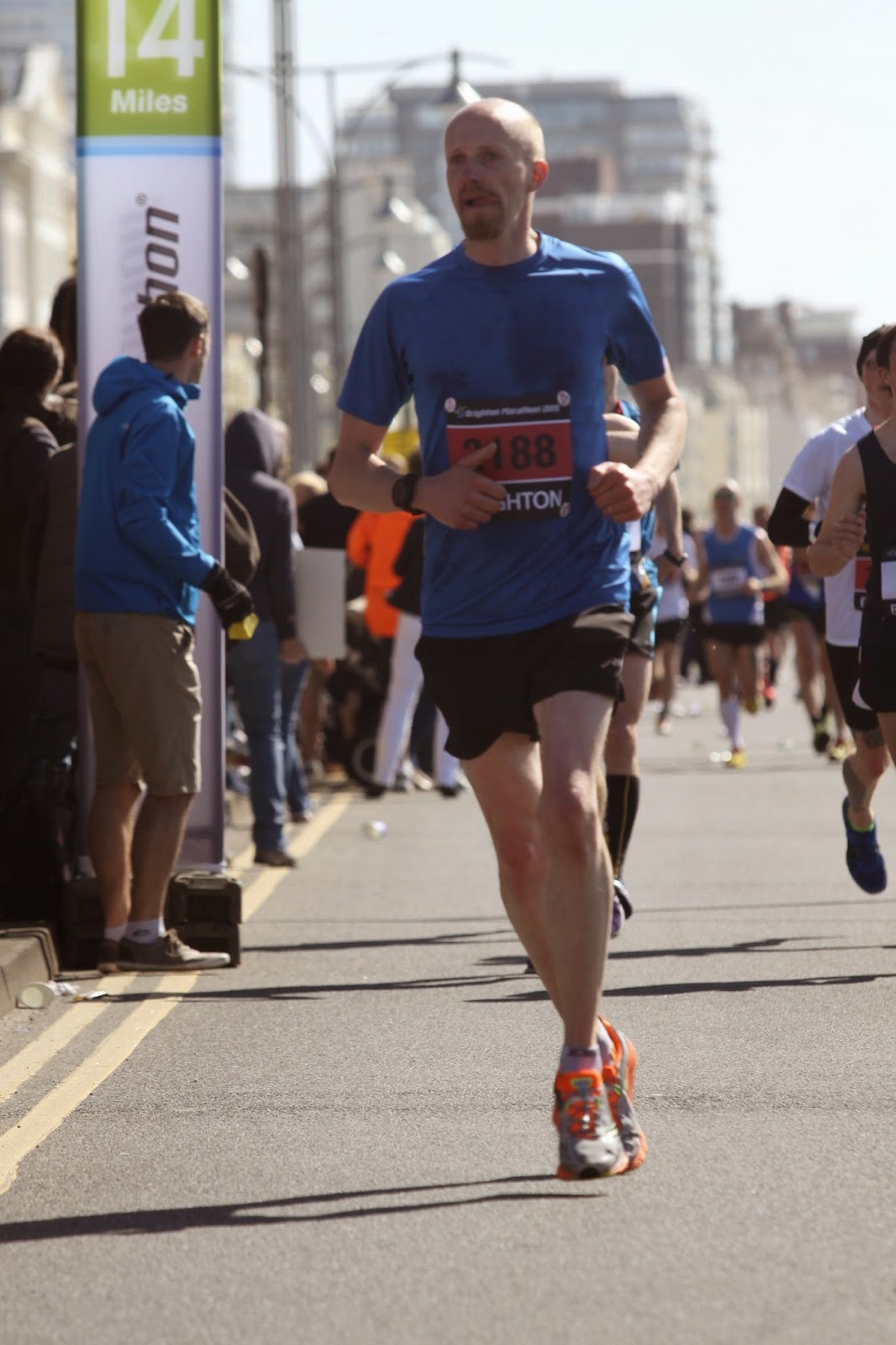
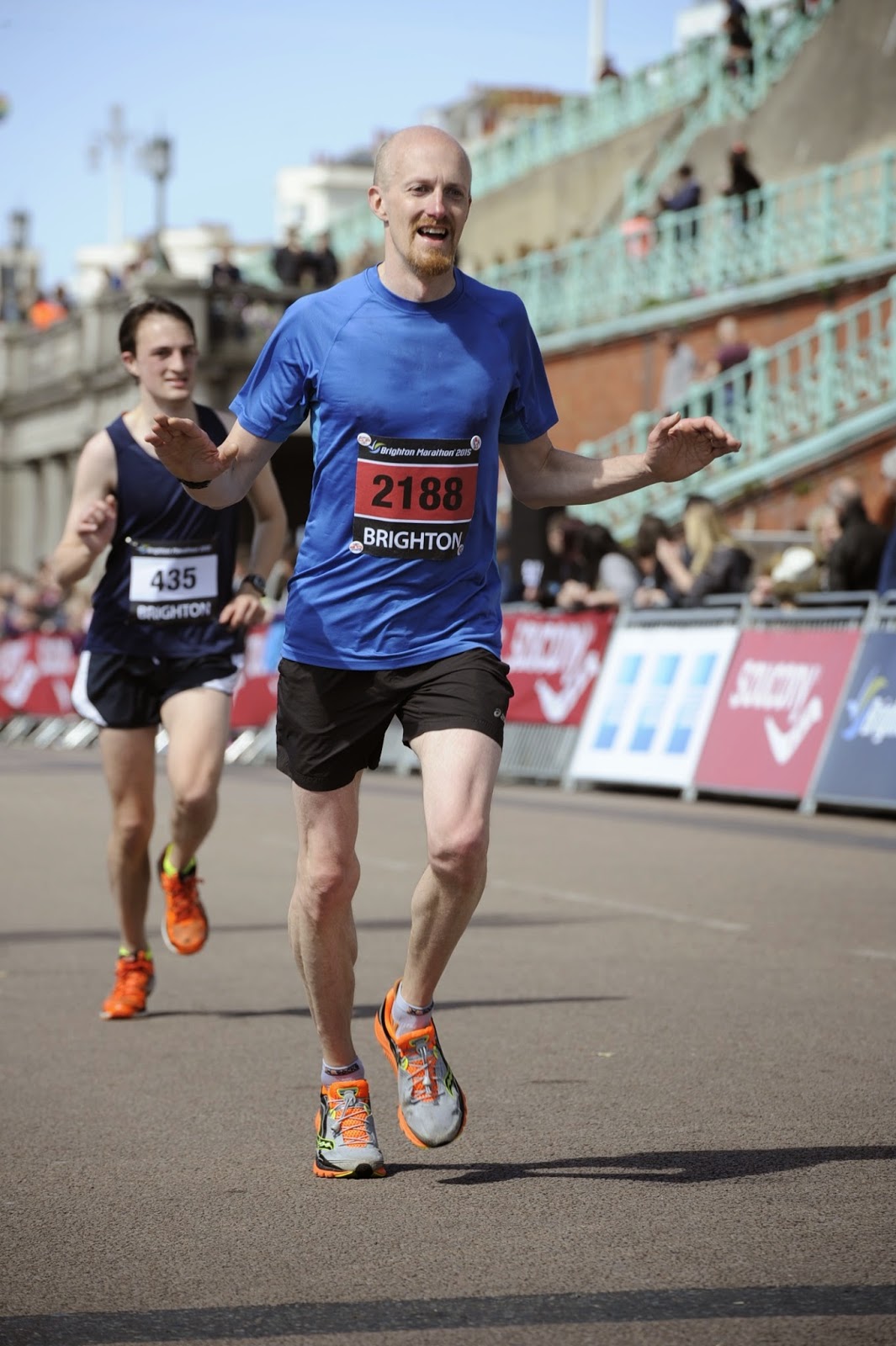
Fortunately by this time I'd made it back into Brighton and the cheering crowds along the seafront and promenade were a massive boost. If you look at some of the race photos, you can see me alternating between pained grimaces one minute and happy smiles the next.

Current pace had dropped to an average of 4:46/km (7:40/mile) for each of these last 3km. However, my watch was displaying an average race pace of 4:23/km (7:04/mile) so I knew I was on for a good time and I therefore didn't try to push any harder and risk a blown hamstring.

The finish

As the finish came into sight I tried to muster up everything I had for a final sprint, and I managed somewhere to pull out a 4:23/km pace for the final finish straight. I crossed the line with a huge smile on my face and a finishing time of 3 hours, 5 minutes and 19 seconds!

Yes, 3:05:19 for my first marathon. I was elated and not at all disappointed at missing that 3 hour mark. In fact by the time I'd reached back pick-up I was already planning my next marathon and how I would knock off those extra 5 and a bit minutes. It was also great to fire up the Brighton Marathon App and see that I finished in an amazing 160th position (165th on chip time), far higher up the standings than I ever thought was possible.

Recovery

I met up with my family and, as suggested by my sports masseur, I went and stood in the sea for 10 minutes to give my legs an early ice bath. It was then straight into compression tights and off for a nice meal to celebrate. Sunday evening and Monday morning were a bit painful as my legs started to stiffen up, but another ice bath and keeping active really helped. By Tuesday morning everything was feeling good again and with a couple of sessions on the foam roller I was out doing a 5k recovery run on the Thursday morning.

Race Assessment

So, I've finished my first marathon in a really good time, but I struggled at the end. My recent half marathon PBs suggest I could have gone faster, so what let me down?

Pacing

I did go out at a slightly faster pace in the first third than originally planned, but only by about 3 seconds per km. I also felt that I was running the first third at a relatively comfortable effort. By half way I was slightly up on where I had expected to be but spot on for a 3-hour time. All I needed to do was maintain a steady 4:15/km pace for the second half of the race. This should have been achievable based on my training and recent half marathon experiences.

I'm not sure whether I underestimated how tough the second half would be or whether the weather and hydration difficulties described below caused my pace to drop off, but I still think I'm capable of running the 4:15/km average pace for the entire distance.

Nutrition

I think I got my nutrition pretty much spot on. At no point did I feel depleted of energy and I certainly didn't hit the legendary 'wall'. After the race was complete I didn't experience any post-race energy dip or excessive tiredness so I think I must have got both my pre-race and in-race fuelling correct.

Hydration

It was hydration that I think really killed the final stages of the marathon for me. I found drinking from the paper cups far harder than I expected. I found that at most drink stations I spilt about half the water while trying to collect the cup and squeeze the top together into a funnel. This meant that I was probably only getting a couple of mouthfuls of water per drink station.

Given the weather conditions (see below) I think I was therefore loosing far more liquid than I was taking on board, even though I took a drink from every station. This certainly accounts for the gradual loss of performance in the later stages plus the early signs of muscle cramps in the last few km. I certainly wasn't unique in this situation as I saw so many people suffering during the last 10km, many having pulled up with cramp.

With hindsight I probably should have made the effort to slow down at the drink stations so as to not spill so much and therefore be able to get more water on board. Someone also mentioned in their post-race analysis that they got their wife to pass them drink bottles at a couple of points in the race. I'd never thought of that, but it's certainly an option that I will consider having available in the future.

Weather

Coupled with the difficulty I had taking on water, I think the weather conditions on the day contributed significantly to dehydration problems. It was a clear, sunny and warm day. However, the stiff sea breeze made it feel much cooler than it actually was. I think this resulted in a number of things happening:

  1. Extra effort was needed to run into the wind at a few points along the course. This resulted in more exertion that I didn't take account of in my pacing.
  2. The higher than expected temperatures and warm sun was causing more perspiration than expected (certainly much more than I'd been used to in any of my early morning training runs), but I didn't feel that I was getting hot at any point due to the cool breeze.
  3. The strong breeze was drying perspiration very quickly so it wasn't obvious just how much fluid I was loosing from sweating.

In all my previous races all I’ve needed to worry about was pacing in a head or tail wind or looking out for sunburn. This was the first race where weather had a significant impact on my performance and, given the length of the race, I needed to take it into account, but I didn’t do so successfully.

Learnings For Next Time

So, I’ve completed my first marathon in a really good time. I’ve got my good-for-age time for London in 2016 (unless they change the rules/requirements). What did I learn that I will do different next year?

Training plan adjustments

I was really happy with the P&D training plan that I followed. It seemed to work very well for me and the pacing discipline and strong scientific grounding really allowed me to have confidence in the plan.

The one change that I would make when using it again would be to add some additional marathon pace work and adjust when this occurs in the run.

First off I’d make sure that all of my long runs finish with a couple of kilometres at marathon pace. I feel that this would better prepare my legs for dealing with that last few km of the marathon when they are tired and when maintaining pace is essential for a fast time.

Additionally, in the plan there were a few marathon paced long runs, but I executed them as a short warm-up, marathon pace section and then the remainder of the long run at slow pace. When following the plan in future I will do all of the slow pace work first and then position the marathon pace work at the end. Again, the goal will be not to teach the legs to run a marathon pace (they can already do that) but to teach them to do it when they are tired.

Hydration strategy and practice

If the next race I do is planning to use paper cups for water I’ll be setting up a drinks station in my road and practicing and practicing until I can pick up cups and drink a decent amount from them without spillage! I really should have done that before Brighton but I just didn’t consider it such an issue.

I’m also certainly going to be going away and researching hydration strategies, fluid loss to perspiration and so forth. There are systems you can use whereby you weigh yourself before and after runs at different efforts and in different temperatures. From these it is possible to determine your expected rate of fluid loss and then use this as to plan and influence how much and how often you need to drink during a race. I plan to never go into a race again without having full certainty on how much fluid I need to consume.

Finally, if I have supporters coming along to cheer me on at my next marathon I will be making sure they are each armed with a disposable bottle of water with an added electrolyte tablet. That way if I’m struggling to take on enough water at drink stations I can always be sure that there will be a good alternative option available.

Strategy improvements

I still think my pacing strategy was reasonably sound and I think I followed it fairly successfully. However, for my next marathon I will aim to be much more precise with pacing in the early part of the race and not let myself get too carried away (even if it’s only by a few seconds per kilometre).

I’ve also learnt that as the distance of the race increases I need to take much more note of the weather conditions and adjust my expectations and pacing plan accordingly. In particular, I need to make sure I’m not over exerting into a headwind and getting the most from a tailwind rather than trying to maintain a consistent pace throughout.

The Next Marathon

Now that my first marathon is complete I’m already planning the next. Provided the rules don’t change I’ll be planning to exercise my good-for-age entry into the Virgin London Marathon in 2016. And I’ll be working really hard to get that sub 3-hour time on my next attempt.

Journey to My First Marathon – Part 3

On 12th April 2015 I took part in Brighton Marathon, my first ever marathon event. In this series of four posts I will be talking about my marathon build-up, training, performance and what I learnt along the way.

In the previous post I looked at how I followed my training plan and managed my nutrition during the training period.

In this third post I'm going to cover my race preparation and race day strategy.

Race Preparation

After booking in to Brighton Marathon I'd also entered both Bath and Reading half marathons as race preparation events. Bath was six weeks before Brighton and Reading just three. The aim was to run Bath as a flat out effort to assess progress and then run Reading as marathon paced training run.

Bath Half

My plan going in to Bath Half was to aim to run in the 4:05/km to 4:10/km pace range (6:35 to 6:40 per mile) and then, if feeling strong, pick up the pace towards the end of the race. The day dawned pleasant but with a fairly strong breeze that would present itself as a headwind for a significant part of the course.

Even with the wind, I had a cracking run at Bath and reduced my PB from 1:30:01 down to 1:26:09. I also managed to run each of the last 5 kilometres at sub-4:00/km pace and still felt that I had a bit left in the tank as well. This gave me a lot of confidence that my training plan was going well. I was really glad I made the effort to include this additional race into my calendar.

Reading Half

My great result at Bath left me with a small dilemma for Reading. I'd always planned to run this race as a marathon pace training effort, but I still felt I could run a faster half marathon, especially if the conditions were more favourable.

I weighed up the options as decided that as I was feeling strong and healthy I would therefore race Reading rather than treat it as a training run. My reasoning being that another really strong half marathon would give me a greater confidence boost than just completing another training run.

My feeling was correct and I was able to maintain an average 3:58/km (6:24/mile) pace for an improved PB of 1:24:33. This was the exact confidence boost that I has hoped for. The only downside was that a second full effort half marathon in just three weeks made for a slower recovery. But, with the taper for Brighton started and a sports massage in the middle of the taper I was able to get the legs back in good shape in plenty of time.

I'd strongly recommend that if you are approaching a marathon you include a couple of races in the couple of months before. Having more race experience and a way to measure the result of your training makes planning for the marathon a much easier task. If you can also hit a PB in a shorted event along the way then you are setting yourself up with a great mindset going into the big day.

Race Strategy

I'd been thinking long and hard about race strategy for months, but this became a major consideration in the three weeks leading up to the race.

Pacing

When I signed up for Brighton, my target time was 3:10:00. This seemed appropriate given my then half marathon PB of 1:30:01 and my goal of a good-for-age entry to London in 2016 (which requires a sub-3:15 marathon for the 41-50 age group). My initial race plan was therefore to target a steady pace of 4:24/km (7:05/mile) which would result in a time of 3:07:00 - giving some buffer time for a slow start, congestion on the course, slowing at drink stations and similar.

However, my great results at Bath and Reading half marathons got me really starting to question whether my target time and strategy were aggressive enough, especially given how well my training had gone. A half marathon time of 1:24:33 put me tantalisingly close to being able to break the magic three hour marathon mark. My feeling was that it would be really great to hit this milestone in my debut marathon, but at the same time I didn't want to risk going too hard, detonating and missing my good-for-age target time.

After much deliberation I decided on a strategy that would give me an opportunity to target a sub-three hour time if things were going well but that wouldn't take too much out of me early in the race, saving energy for if things got tough. The final strategy that I went into the race with was:

  • Start to 14km (9 miles): 4:20/km (7:00/mile)
  • 14km to 28km (miles 9 to 18): 4:15/km (6:50/mile)
  • 28km to end (18 miles+): If feeling strong then 4:10/km (6:40/mile) otherwise remain at 4:15/km

If all went well then this would average out at around 4:15/km, which would be pretty much spot on the 3 hour mark. I was also quietly confident of being able to maintain the slower 4:15/km pace for the final third of the race if things weren't working out. As it turns out, I wasn't able to fully follow this plan, but that's a subject for the final post in this series.

Nutrition

Given my fairly low carb, high fat and protein paleo diet, I opted to avoid the typical massive carb fest in the few days before the race. Instead I just ate my normal diet but substituted porridge into my breakfast and rice into my evening meals. I was pretty confident with my body's ability to efficiently burn fuel based on the vast number of mostly fasted miles I'd put in over the months of training.

Race day breakfast was my usual large bowl of porridge with a 33Shake All In One Shake mixed in. I usually eat this three hours before the start of the race.

About an hour before the race I then have a couple of low fat and fibre ginger cookies that I make following a recipe on Runners World. I find these nicely settle my tummy without causing any digestion problems during the race.

In-race nutrition was to be provided by four 33Shake Chia Gels, which I would consume at kilometres 8, 16, 24 and 32 (miles 5, 10, 15 and 20). I've been training with these natural energy gels for months and have found them very digestable with a good slow release of energy, rather than the massive sugar hit and crash that you get with normal energy gels.

Hydration

My pre-race hydration plan is to drink plenty of water with breakfast. This ensures good starting hydration levels for the day but gives you an opportunity to flush everything through before lining up to race. Definitely don't want to be starting out with a partly-full bladder and needing to take a pee stop mid-race. I then sip some water on the start line just as a final top up before the off. I didn't see any reason to change this strategy that has always worked for me in the past.

For this year, Brighton Marathon opted to use paper cups, instead of the more common pouches or bottles, for both water and gatorade. Their stated reasons for this choice being that it's more environmentally friendly and also that it allows them to have drink stations every mile throughout the race.

My plan was to consume only water, as I haven't ever used any energy drinks and don't really see the need to do so. With drink stations every mile, I intended to take on water every other mile and therefore have the option for additional water if needed in the intermediate period.

I didn't bother practising with cups as I've used them in previous (10k) races with no trouble. I also didn't even consider the prospect of having additional fluid handed to me along the course. As we will see in the final part of this series, these omissions may have been a less than ideal strategy.

Ready to Race

With a successful preparation and a clear race strategy it was time to get down to the running. My performance in the race and what I learnt as a result will be the subject of the final post in this series.

Sunday, 2 March 2014

Pacing the Half Marathon

This weekend I took part in Reading Half Marathon. I crossed the line in 1:30:01, a personal best by over 7 minutes. My 12 week, 390 mile training plan prepared me fantastically well. The only downside to the day was missing the sub-1:30 time by a tantalising 2 seconds. This was purely down to a very simple mis-calculation in my pace timing.

The Goal

Prior to the race my goal was a sub-1:32 finish time for the 13.1 miles, with a stretch goal of sub-1:30. I knew I would be comfortable for the 1:32 finish as I'd done plenty of training at the 7:00 per mile pace needed to achieve this. I was however unsure about my ability to sustain a 6:50 pace for the full distance, despite having achieved this pace for a couple of miles at a time in training.

I therefore decided a pacing plan starting at the 1:32 pace to get into my stride and then gradually speeding up to reach the sub-1:30 stretch goal. That way if it was getting too tough then I would be able to back off back to the 1:32 pace and still meet my main goal.

By starting slower as well it makes it less stressful dealing with the first couple of miles of crowded roads and the overtaking of all those people who, for some reason, seem to insist on setting out at the front of the race at a pace they can't sustain for even the first mile! (rant over).

So, my plan was as follows: 07:00 per mile for the first 4 miles, 06:50 per mile for miles 5 to 8, and finally 06:45 per mile for the last 5.1. Following this plan would get me home at 1:29:42, giving an 18 second margin for any small mistakes or misjudgements.

The Reality

So, the first 4 miles went well with 7:03, 6:58, 7:02 and a 6:46 (slightly fast on the last one, but then it was downhill). At this point I was still feeling strong, so decided to up to the faster pace. Miles 5 to 8 were solid at 6:42, 6:29, 6:54 and 6:55 (downhill for two and then uphill for two). At this point I was ahead of my scheduled 8 mile split time by about 24 seconds and still feeling good.

Now was the time to make a decision, so I picked up the pace again and ran the next 5 miles at 6:49, 6:42, 6:41, 6:51 and 6:49. Not so pleased with miles 12 and 13, but they were into a headwind and I still thought I was up by enough that loosing 10 seconds didn’t matter.

Then came the problem, running time to this point was 1:28:43 and supposedly only 0.1 miles left. However, not being able to run the optimal racing line at all times and having to weave a bit to overtake meant I was still 0.2 miles from the line! Realising this I dug as deep as possible and tried to pick up the pace. Managed a 6:15 per mile pace sprint, but by that time it was too late to pull back those vital few seconds.

The Lesson

So, I missed my sub-1:30 stretch goal by just 2 seconds and all down to planning for 13.1 miles rather than the 13.21 that I actually ran. Had I thought about that initially I'm sure I could have planned a single second faster on each mile throughout the race and been able to hit those splits.

Lesson for the future: unless you are right at the front of the race, plan to run slightly further than the actual race distance and plan the splits accordingly.